
AI Didn't Replace Their Jobs. It Gave Them Their Jobs Back.
What happens when a small arts and crafts business embraces AI, not to replace employees, but to help them thrive? This case study explores how technology helped a five-person retailer grow into a nine-person business, increase profitability, improve job satisfaction and rediscover the importance of human creativity and connection.
Published 18 Oct 2026, 03:00 BST · Last edited 18 Oct 2026, 03:00 BSTShare this page ↗
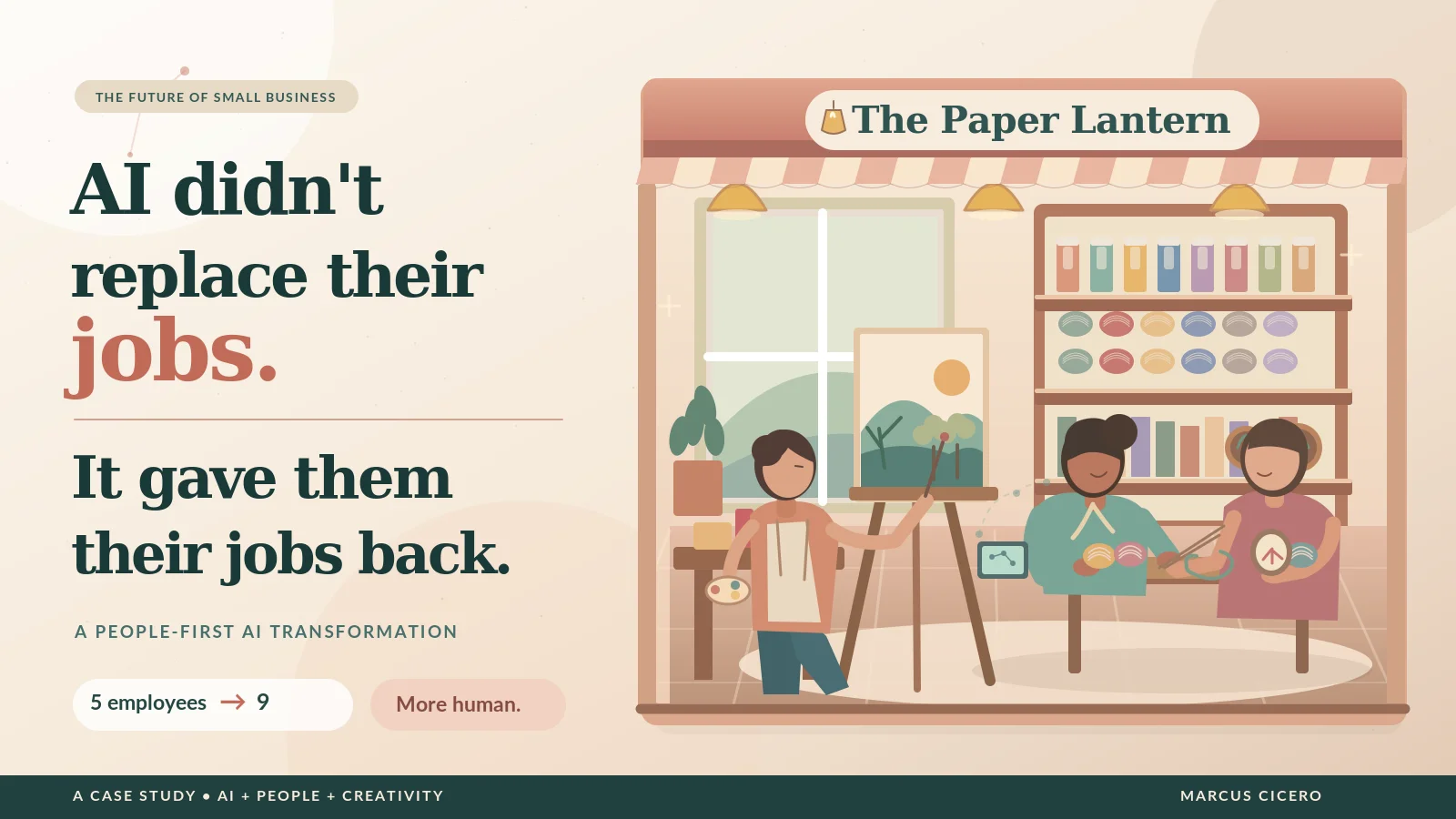
How artificial intelligence helped transform a struggling independent arts and crafts retailer into a thriving business, creating four new jobs and making its employees happier in the process.
By Marcus Cicero | AI Research & Digital Transformation
What if artificial intelligence wasn't coming for your job, but for all those frustrating little tasks that stop you from enjoying it?
We hear plenty about AI replacing workers, eliminating jobs and making human beings increasingly redundant.
But there's another side to that conversation. One that doesn't receive nearly as much attention.
What happens when a business embraces artificial intelligence, not to reduce its workforce, but to give its employees more freedom to be creative, develop their skills, connect with customers and explore opportunities that previously seemed impossible?
What happens when technology takes care of the repetitive work, leaving people to concentrate on the things that actually make them valuable?
And what if introducing AI resulted in a business employing more people rather than fewer?
To explore those questions, I'd like to introduce you to The Paper Lantern.*
This case study takes you through all the challenges, mistakes, unexpected opportunities and eventual results of introducing AI into a small independent retailer.
Because sometimes the most interesting thing about technology isn't what it can do.
It's what it allows people to do instead.
Meet The Paper Lantern
* Note: At the owner’s request, the business described here is referred to by a fictitious name. Anonymising the company allows me to share its results openly, including financial performance, while protecting its commercial position and the privacy of the people involved. The figures and events described are real and are shared with the owner’s full consent.
Imagine a charming independent arts and crafts shop tucked away off a typical British high street.
The sort of place where you walk in looking for a birthday card and emerge forty minutes later carrying a set of watercolour paints, three balls of wool, a cross-stitch kit and an inexplicable determination to become the next great landscape artist.
Welcome to The Paper Lantern.
The shop specialises in arts, crafts and creative hobbies, stocking everything from professional art supplies to beginner-friendly crafting kits.
Its shelves are packed with watercolours, acrylic paints, brushes, canvases, sketchbooks, drawing pencils, calligraphy pens and beautiful handmade papers.
Elsewhere, you'll find colourful yarns, knitting needles, crochet hooks, embroidery threads, cross-stitch kits, sewing accessories, needlecraft patterns, crafting materials and all manner of things that inspire people to create.
There's also a popular stationery section, with fountain pens, inks, premium journals and writing accessories.
The business caters to everyone from professional artists and experienced crafters to complete beginners who wouldn't know which end of a crochet hook to hold.
What makes The Paper Lantern special isn't simply its product range.
It's the people.
Its employees are passionate about creativity.
One is a talented watercolour painter. Another has been knitting and crocheting since childhood. A third knows more about embroidery and cross-stitch than most people could learn in a lifetime.
They love sharing their knowledge, helping customers and encouraging people to explore new hobbies.
Unfortunately, there's a problem.
They barely have time to do any of it.
Five Employees, a Thousand Jobs
When I was brought in to oversee the business's digital transformation, The Paper Lantern employed five people, including its owner.
The business had a loyal customer base, a reasonable online presence and a reputation for excellent personal service.
But it was struggling to grow.
Not because customers weren't interested in its products.
Quite the opposite.
The problem was that every additional sale seemed to create more administrative work.
More stock to monitor.
More supplier invoices.
More customer enquiries.
More emails.
More website updates.
More spreadsheets.
More time spent managing the business rather than developing it.
The original team consisted of:
| Role | Responsibilities |
|---|---|
| Owner and Managing Director | Finances, strategy, purchasing, supplier relationships and general management |
| Store Manager | Daily operations, customer service, sales and staff coordination |
| Arts and Crafts Specialist | Product advice, demonstrations, merchandising and customer support |
| Operations Coordinator | Stock management, orders, deliveries and administration |
| Marketing and Customer Relations Assistant | Website updates, promotional material, emails and social media |
Like many small businesses, everyone wore several hats.
The arts and crafts specialist might spend twenty minutes enthusiastically explaining the difference between watercolour and acrylic painting, only to return to manually updating stock records.
The operations coordinator spent hours reconciling orders and checking supplier information.
The marketing assistant had some wonderful ideas for creative campaigns but rarely had enough time to implement them.
And the owner routinely spent her evenings dealing with spreadsheets and emails that hadn't been addressed during the day.
Nobody was lazy.
Nobody lacked ambition.
They were simply overwhelmed.
The First Employee Satisfaction Survey
Before introducing any technology, I wanted to understand how the employees actually felt.
I conducted a simple anonymous survey, asking everyone to rate their overall job satisfaction from 1 to 10.
The results weren't encouraging.
The average was just 3.5 out of 10.
Interestingly, the employees weren't particularly unhappy with their colleagues, customers or even the business itself.
Their frustration came from how their time was being spent.
They felt constantly interrupted.
They rarely had opportunities to learn new skills.
Their creative ideas were regularly postponed because something more urgent needed doing.
And despite working hard, they often finished the day feeling they'd accomplished very little of real importance.
One employee offered an observation that stuck with me:
"I came here because I love arts and crafts. Most days I feel like I work in a spreadsheet factory that just so happens to sell paint."
That was the moment I knew where we needed to begin.
The Goal Wasn't to Replace People
My brief was to modernise the business, improve efficiency, identify opportunities for growth and increase profitability.
But I established one fundamental principle from the outset.
We weren't implementing AI to find out how many employees we could get rid of.
We were implementing it to discover how much more the existing employees could achieve.
Too often, businesses approach automation by asking how many hours of labour they can eliminate.
It's an understandable calculation, particularly when finances are tight.
But it's also a remarkably narrow way of looking at the opportunities technology presents.
I was more interested in asking what the employees might accomplish if they suddenly had the time to concentrate on their strengths.
Could they introduce new products?
Could they organise workshops?
Could they develop relationships with schools and community organisations?
Could they collaborate with local artists?
Could they create experiences that customers couldn't get from a large online retailer?
And could doing those things make the business more profitable?
Before answering any of those questions, however, we needed to address the enormous amount of time being wasted on repetitive work.
Phase One: Let the Machines Do the Boring Stuff
My first step was to map the business's existing processes.
I examined how information moved between the tills, website, inventory database, email accounts, suppliers and customer records.
We identified where employees were repeatedly entering the same information, manually checking figures or spending time on tasks that followed predictable patterns.
Not everything required artificial intelligence.
Some problems were solved through straightforward software integrations and conventional automation.
Others benefited from specialised AI tools, language models and automated agents.
The important thing was selecting the right solution for each problem.
Email Management
Previously, staff spent hours sorting customer enquiries, supplier correspondence, invoices, delivery notifications and promotional emails.
We introduced an AI-assisted email system capable of categorising incoming messages, identifying urgent issues, extracting relevant information and preparing draft responses.
Customer questions about opening hours, delivery policies or product availability could be handled quickly.
Complex enquiries were directed to the appropriate employee.
Supplier messages were summarised, and routine administrative information was processed automatically where appropriate.
Instead of arriving each morning to an intimidating inbox, employees received a prioritised overview of what genuinely required their attention.
AI handled much of the sorting.
Humans handled the conversations.
Stock Management and Sales Forecasting
Managing inventory in an arts and crafts shop is surprisingly complicated.
Different paint colours sell at different rates.
Certain yarns become popular because of seasonal trends.
Cross-stitch kits experience fluctuations in demand.
Christmas brings increased interest in gift sets and beginner craft kits.
Previously, employees manually examined sales reports and stock spreadsheets to identify what needed ordering.
We connected the sales and inventory systems to an AI-assisted forecasting tool.
The system could identify emerging trends, unusual purchasing patterns, seasonal demand and potential stock shortages.
For example, it might discover that sales of beginner watercolour sets increased significantly after a local art exhibition.
Or that interest in embroidery kits was growing among younger customers.
Or that certain colours of wool were consistently selling out long before the others.
The technology could highlight these opportunities and recommend purchasing decisions.
But staff retained responsibility for approving orders and applying their specialist knowledge.
After all, a computer might identify that a particular yarn is selling well.
An experienced knitter can explain why.
Customer Enquiries
We also introduced an AI-assisted customer information system.
It answered straightforward questions about stock availability, order progress, opening hours and delivery arrangements.
But we deliberately avoided allowing it to replace more meaningful customer interactions.
If somebody wanted to know whether a particular brand of acrylic paint was in stock, the system could help.
If somebody wanted advice about taking up painting after retiring, that was a conversation for a human being.
If a customer was struggling to choose a cross-stitch project for their grandmother, the shop's employees were far better placed to offer thoughtful guidance.
We weren't trying to remove human interaction from the business. We were removing the unnecessary interruptions that prevented it.
The First Results
After several months, we estimated that the original five employees were collectively saving approximately 40 to 45 hours per week on repetitive administrative tasks.
That's roughly the equivalent of an additional full-time working week.
Now, a business focused entirely on reducing staffing costs might have regarded that as an opportunity to eliminate a position.
We saw something completely different.
We had effectively created forty additional hours of productive capacity without recruiting anyone.
And we were going to use them.
Phase Two: Things Actually Got Worse
Before anyone gets carried away with visions of effortless technological transformation, there's something important I need to explain.
The initial results looked encouraging.
But the employees weren't happy.
In fact, their job satisfaction scores actually fell.
Our second survey produced an average of approximately 2.5 out of 10.
Lower than when we'd started.
Hardly the glowing endorsement a digital transformation consultant hopes to receive.
So what had gone wrong?
Nothing particularly unusual.
We'd introduced change.
And change is uncomfortable.
Employees who'd spent years developing familiar routines were suddenly being asked to work differently.
One worried that the new systems would eventually make their job redundant.
Another was frustrated by the learning curve.
There were technical issues, mistakes and processes that initially required more effort than the systems they replaced.
And some employees found themselves learning new software while still completing their existing responsibilities.
One employee asked a perfectly reasonable question:
"If AI can do all this, what exactly am I supposed to be doing in six months?"
It was a question we needed to answer.
Not with vague promises about the future of technology, but with a clear explanation of where the business was heading and how employees would be involved.
Making People Part of the Transformation
We changed our approach.
Instead of focusing primarily on what the technology could do, we concentrated on what employees wanted to achieve.
We introduced dedicated training time during working hours.
Employees were encouraged to experiment with new tools, challenge the AI's recommendations and suggest improvements.
We made it clear that AI wasn't there to monitor their every movement, judge their performance or make decisions about their employment.
It was there to support them.
Most importantly, we began discussing the opportunities the technology was creating.
The painter wanted to teach.
The knitter wanted to organise a social crafting group.
The marketing assistant wanted to develop more ambitious campaigns.
The owner wanted to build relationships with local businesses.
Suddenly, the conversation changed.
Instead of asking which jobs AI would eliminate, we were discussing which new activities the employees could pursue.
The biggest challenge wasn't teaching people to use AI. It was helping them realise they were still the most important part of the business.
Phase Three: Discovering Opportunities Hidden in the Data
Once the initial systems were established, we began using AI for something considerably more interesting than sorting emails.
Business development.
We introduced AI-assisted tools to analyse sales patterns, identify potential markets and research opportunities.
The systems combined information from the shop's own sales records with appropriate market research and publicly available business information.
The results challenged several assumptions about the business.
For example, our analysis suggested that many customers weren't simply purchasing materials.
They were buying the possibility of a new hobby.
A beginner purchasing a watercolour set wasn't necessarily looking for the cheapest paint.
They wanted reassurance that they could actually learn to paint.
A customer buying knitting needles might benefit from an introductory lesson.
Someone purchasing a cross-stitch kit could be interested in joining a group of people who shared their hobby.
And parents buying children's crafting materials might welcome organised creative activities during school holidays.
This was an important discovery.
The Paper Lantern wasn't just selling products. It was selling opportunities to create, learn and connect.
That gave us an entirely different way to think about the business.
Diversifying the Business
We identified several opportunities to develop new revenue streams.
- Creative workshops: Watercolour painting, acrylic techniques, crochet, knitting, embroidery, cross-stitch, calligraphy and children's craft sessions.
- Crafting clubs: Regular social gatherings where customers could work on projects, exchange ideas and learn from one another.
- Subscription boxes: Monthly themed craft kits containing materials, project instructions and occasionally exclusive products from local creators.
- Corporate workshops: Creative team-building experiences for organisations looking for something different from the usual office activities.
- Educational partnerships: Collaborations with schools, colleges, adult learning groups and community organisations.
- Personalised gifts: Bespoke embroidery kits, customised craft packages, personalised journals and curated creative gift sets.
- Local artist collaborations: Limited-edition products, commissioned designs and opportunities for independent craftspeople to showcase their work.
None of these ideas required abandoning the existing business.
They were natural extensions of what it already did.
AI helped us recognise the opportunities, estimate their potential and prioritise which ones to explore.
But the employees provided the enthusiasm, specialist knowledge and creativity needed to bring them to life.
Phase Four: The Shop Becomes a Community
One of our first experiments was a beginner watercolour workshop.
The arts and crafts specialist had wanted to organise something similar for years but never had the time.
Now they did.
We used AI to help plan the workshop, estimate material costs, research appropriate pricing and prepare the initial promotional campaign.
But the actual experience was entirely human.
Participants learned basic painting techniques, experimented with colour mixing and produced their first small landscape paintings.
Some were nervous.
Others were convinced they had absolutely no artistic ability.
A few discovered talents they hadn't realised they possessed.
The workshop was fully booked.
So we organised another.
Then a beginner crochet class.
Then a cross-stitch afternoon.
Then a monthly knitting and crochet social group.
Before long, the shop had developed a regular programme of creative events.
Customers who'd previously visited once every few months were now returning regularly.
People who initially came to purchase materials were developing friendships.
Beginners became enthusiasts.
Enthusiasts introduced their friends.
And those friendships created something no amount of automated marketing could manufacture.
A genuine community.
The Human Touch Became Our Competitive Advantage
One of the most interesting consequences was the improvement in customer relationships.
Employees now had time to remember customers' interests.
They could ask how a knitting project was progressing.
They could suggest complementary products.
They could recommend a workshop to someone who seemed interested but lacked confidence.
They could spend time talking to an older customer who lived alone and visited partly for the company.
These interactions weren't distractions from productivity.
They were an important part of what made the business successful.
Customers could purchase paints, wool and cross-stitch kits from enormous online retailers.
But those retailers couldn't easily recreate the experience of being welcomed into a shop where people knew their interests, remembered their projects and genuinely cared about their progress.
Ironically, introducing more technology had made the business more human.
Phase Five: AI Marketing Opens Doors for Human Creativity
The next major change involved marketing.
Previously, promotional activity had been irregular.
The marketing assistant was responsible for maintaining the website, responding to customers, updating product listings and creating social media posts.
There simply wasn't enough time to develop a coherent marketing strategy.
And there wasn't enough money to regularly commission professional photography, illustration or graphic design.
Generative AI changed the starting point.
We introduced tools to assist with social media planning, product descriptions, promotional copy, campaign ideas and visual concepts.
The shop began publishing more consistent content.
We developed themed campaigns around new hobbies, seasonal crafts, gift ideas and upcoming workshops.
AI helped produce early promotional material and explore different creative directions.
The marketing assistant could now spend more time thinking about what would actually interest customers rather than struggling to create every individual graphic.
But this was never intended to replace professional creative work permanently.
Quite the opposite.
From AI-Generated Graphics to Professional Designers
As revenue and profitability increased, The Paper Lantern could finally invest in professional branding.
We commissioned independent graphic designers to develop a distinctive visual identity.
Professional photographers produced beautiful images of products, workshops and local craftspeople.
Illustrators created bespoke artwork for seasonal campaigns and subscription-box packaging.
Local artists contributed designs for limited-edition products.
The business began investing in exactly the kind of creative professionals that people sometimes fear AI will replace.
And there was a simple reason.
The technology had helped the business become successful enough to afford them.
Generative AI had made basic marketing more accessible when resources were limited.
As the business grew, professionally commissioned work helped establish a stronger, more distinctive brand.
The two approaches weren't mutually exclusive.
AI continued to assist with research, planning and experimentation.
Human designers supplied the originality, craftsmanship and professional expertise that gave the brand its identity.
This is an important point.
AI doesn't have to replace creativity.
Used thoughtfully, it can help businesses invest more in it.
Phase Six: Finding New Customers and Building Relationships
With new services and a stronger online presence, we turned our attention to business development.
We introduced an AI-assisted lead identification system.
It researched suitable organisations, highlighted potential opportunities and prepared background information for the employees responsible for developing relationships.
For example, it helped identify local employers that might be interested in creative team-building sessions.
It highlighted community organisations offering wellbeing activities.
It identified potential opportunities with schools, wedding planners, event organisers and independent retailers.
It also helped research artists and craftspeople who might be interested in collaborations.
But we deliberately avoided turning this into an indiscriminate automated outreach operation.
We used relevant public business information, respected marketing permissions and kept personal correspondence under human oversight.
AI helped identify who might benefit from the business's services.
People were responsible for building the relationships.
Sending five hundred automated emails is relatively easy.
Developing a trusted relationship with a local organisation that leads to years of successful collaboration is something else entirely.
And those relationships became increasingly valuable.
One corporate workshop could introduce twenty potential new customers.
A partnership with a local school could generate recurring demand for art materials.
A collaboration with an independent artist could produce exclusive products unavailable anywhere else.
The opportunities began reinforcing one another.
Phase Seven: We Needed More Employees, Not Fewer
At this point, something rather unexpected happened.
The business was growing faster than the original team could comfortably manage.
Online sales were increasing.
Workshops were becoming popular.
Corporate enquiries were more frequent.
Social media engagement had improved.
The subscription boxes were gaining customers.
And the business was developing partnerships with local artists, schools and community organisations.
The original five employees were working more effectively and were considerably happier.
But even with AI supporting the administrative workload, there was a limit to what five people could accomplish.
So we recruited.
Four additional employees joined The Paper Lantern.
Not to replace the original team.
Not to spend their days processing the same repetitive tasks we'd automated.
They were hired to help the business expand into areas that required creativity, judgement, specialist knowledge and human relationships.
Employee Six: Social Media and Digital Content Specialist
Our first new recruit concentrated on building the shop's online community.
They created original videos, interviewed local artists, filmed crafting demonstrations and developed engaging social media campaigns.
AI supported content planning, audience analysis and performance reporting.
But the employee provided the personality, imagination and genuine interaction.
They weren't simply posting advertisements.
They were telling the stories behind the products and the people who used them.
Employee Seven: Business Development and Partnerships Manager
The second recruit focused on developing commercial relationships.
They worked with schools, companies, community groups, local artists and event organisers.
AI assisted with research, lead identification and preparing proposals.
But the employee attended meetings, visited organisations and developed partnerships.
They understood that trust wasn't something you could generate with a prompt.
Employee Eight: E-commerce and Customer Experience Coordinator
As the online business expanded, we recruited a specialist to manage the digital shopping experience.
They improved product listings, developed online collections, streamlined fulfilment and analysed customer feedback.
AI helped identify patterns and potential improvements.
The employee used those insights to make shopping easier, more enjoyable and more personal.
They also helped launch new craft subscription boxes, working closely with the original arts and crafts specialist to curate interesting projects.
Employee Nine: Workshops and Community Engagement Coordinator
Our final recruit was responsible for the growing events programme.
They organised workshops, managed bookings, coordinated visiting instructors and developed community activities.
They also helped establish regular crafting groups, including a knitting circle, a cross-stitch club and a monthly creative social evening.
AI assisted with scheduling, booking administration and attendance analysis.
But the actual work was about people.
Welcoming them.
Encouraging them.
Helping them learn.
And ensuring they left feeling they'd enjoyed themselves.
We'd introduced artificial intelligence to a business employing five people. Two years later, it employed nine.
Not one of the original employees had lost their job.
What Happened to the Original Five?
This is possibly my favourite part of the entire transformation.
Because while the additional employees were helping the business expand, the original team had also changed.
The owner was no longer spending every evening dealing with spreadsheets.
She now had time to think strategically, explore new opportunities and develop relationships with suppliers and other businesses.
The store manager could concentrate on creating a welcoming environment, mentoring employees and improving customer service.
The arts and crafts specialist was now teaching workshops, developing product ranges and collaborating with local creatives.
The operations coordinator had moved away from constant manual data entry towards improving systems, supplier relationships and operational efficiency.
And the original marketing assistant had developed into a broader creative and customer engagement role, working alongside the new social media specialist and external designers.
They weren't working fewer hours.
They were just spending more of those hours doing meaningful work.
We also introduced opportunities for professional development.
Employees learned new software, developed their specialist interests and gained experience in areas that would previously have been beyond the scope of their roles.
Some learned more about AI and automation.
Others explored photography, event management, business development and customer experience.
The result wasn't merely a more productive workforce.
It was a more confident and capable one.
The Results: Two Years Later
So what did all this achieve?
| Business Metric | Before AI | Two Years Later |
|---|---|---|
| Employees | 5 | 9 |
| Annual revenue | £450,000 | £800,000 |
| Annual net profit | £36,000 | £88,000 |
| Net profit margin | 8% | 11% |
| Staff job satisfaction | 3.5/10 | 8.6/10 |
| Lowest satisfaction during transition | — | 2.5/10 |
| Weekly repetitive administration, original team | 60 hours | 17 hours |
| Sales channels | Shop and basic website | Retail, e-commerce, subscriptions, workshops and corporate sales |
| Dedicated social media employees | 0 | 1 |
| Dedicated business development employees | 0 | 1 |
| Dedicated events employees | 0 | 1 |
| Professional creative services | Occasional | Regularly commissioned |
| Redundancies caused by AI | — | 0 |
Revenue had increased by approximately 78%.
Annual net profit had more than doubled.
Four additional employees had been recruited.
And the business was investing in professional designers, photographers, local artists and other independent businesses.
Of course, AI wasn't solely responsible for that growth.
The expansion depended on many factors, including customer demand, effective leadership, additional investment, staff development and successful execution.
Technology created opportunities and increased the team's capacity to pursue them.
People turned those opportunities into commercial success.
But there's another figure in that table that I think deserves our attention.
From 3.5 to 2.5 to 8.6
Remember the staff satisfaction surveys?
We started at approximately 3.5 out of 10.
During the uncomfortable transition, that fell to around 2.5.
Two years later, the average was 8.6.
Employees were now regularly reporting satisfaction scores of 8 or 9 out of 10.
Why?
Because they had more opportunities to concentrate on work they found interesting and rewarding.
They could use their expertise.
They could develop their skills.
They could pursue ideas.
They could spend more time with customers.
And they could see how their contributions helped the business grow.
For me, that result is every bit as important as the financial figures.
Because productivity isn't simply about completing more tasks in less time.
It's about achieving more valuable outcomes with the time and resources available.
And there's a substantial difference between being busy and being productive.
The AI Agents Working Behind the Scenes
By the end of the transformation, The Paper Lantern had several specialised AI-assisted workflows supporting its operations.
A Sales Intelligence Agent analysed purchasing patterns, identified emerging trends and suggested potential opportunities.
A Stock Forecasting Agent monitored inventory, seasonal demand and supplier performance.
A Business Development Agent helped research potential customers, partners and commercial opportunities.
A Marketing Assistant supported campaign planning, content development and performance analysis.
A Communications Agent categorised incoming emails, prepared summaries and drafted routine responses.
A Customer Insights Agent analysed feedback and purchasing patterns to help employees understand what customers wanted.
And an Events Assistant helped coordinate workshops, bookings, calendars and attendance information.
These systems weren't an unsupervised army of autonomous robots making every decision.
They operated within defined boundaries, connected to appropriate business systems and provided information or recommendations for employees to review.
Customer information was handled with appropriate privacy safeguards, and commercial decisions remained under human control.
Employees could challenge recommendations, correct mistakes and suggest improvements.
The goal was to create reliable tools that complemented human expertise.
Not mysterious systems that nobody understood or trusted.
AI became part of the business infrastructure, quietly handling tasks that previously consumed valuable human time.
Something Else Happened: The Local Economy Benefited
There's another aspect of this story worth mentioning.
Before the transformation, The Paper Lantern had relatively limited resources.
It employed five people and occasionally purchased external creative services.
As the business grew, its economic contribution expanded.
It now employed nine people.
It commissioned independent graphic designers.
It paid professional photographers.
It collaborated with local artists.
It purchased additional stock from specialist suppliers.
It invited independent craftspeople to lead workshops.
It developed partnerships with schools, community organisations and other local businesses.
Some of its new products were created specifically for the shop by independent makers.
In other words, the increased productivity didn't simply benefit the owner.
It created opportunities for other people and organisations.
Of course, this doesn't mean every business introducing AI will create additional employment.
Some will use automation to reduce their workforce.
Others may struggle to adapt.
And certain roles will undoubtedly change or disappear as technology advances.
Those concerns are legitimate and shouldn't be dismissed.
But neither should we assume that every hour of work automated represents an hour of employment permanently lost.
Sometimes the capacity created by automation allows a business to grow, diversify and support jobs that wouldn't otherwise have existed.
That's an important part of the economic conversation about AI.
Why the Human Touch Matters More Than Ever
One of the most interesting lessons from this transformation is that human interaction became increasingly valuable as the business adopted more technology.
Consider the difference between ordering a cross-stitch kit from an enormous online retailer and visiting The Paper Lantern.
Both can sell you the same product.
Both can offer convenient payment methods.
Both can arrange delivery.
But only one might remember that you've recently started embroidery.
Only one might introduce you to somebody who shares your enthusiasm.
Only one might invite you to a workshop where you'll learn something new and make a few friends.
And only one might employ someone who spends twenty minutes explaining why your knitting keeps going wrong without making you feel like an idiot.
These are the experiences that build loyalty.
They're also the experiences that give employees genuine satisfaction.
A customer isn't simply a transaction.
A shop isn't simply a warehouse with a till.
And an employee isn't simply a collection of tasks that need completing.
When we forget this, we risk turning businesses into remarkably efficient organisations that nobody particularly enjoys working for or buying from.
AI can help us become more efficient. Human beings give that efficiency a purpose.
A Different Way of Measuring Productivity
There's another assumption I'd like to challenge.
We often measure productivity by how much work somebody completes.
How many emails did they answer?
How many orders did they process?
How many customer enquiries did they handle?
How many reports did they produce?
But those measurements don't necessarily tell us whether the work was valuable.
Suppose an employee spends two hours manually preparing a sales report.
Now imagine an AI-assisted system produces the same report in a few minutes, leaving the employee free to spend the remaining time developing a relationship with a potential new customer.
Which activity creates greater value?
Or imagine an employee who previously spent an afternoon updating stock spreadsheets.
Now they use that afternoon to run a beginner watercolour workshop attended by twelve paying customers.
They generate revenue, introduce people to new products and help establish relationships that may last for years.
Which is more productive?
The answer isn't always about how quickly a task can be completed.
Sometimes it's about whether that task needed a human being in the first place.
And what that human being could have accomplished instead.
AI Doesn't Have to Mean Less Human Employment
I want to be careful here.
I'm not suggesting that artificial intelligence will never eliminate jobs.
It will change the labour market, and some occupations will be affected considerably more than others.
Businesses also operate under different financial pressures, and the benefits of automation won't automatically be shared with employees.
Responsible transformation requires planning, investment, training and an honest conversation about how roles may change.
But I reject the assumption that the only possible motivation for introducing AI is to reduce staffing costs.
For a small business, efficiency can be the difference between stagnation and growth.
And growth can create opportunities for employment.
The Paper Lantern is a shining example of what happens when a business uses increased productivity as a foundation for expansion rather than simply as an opportunity to reduce its workforce.
The five original employees didn't become redundant.
They became more capable, more confident and more valuable to the business.
Four additional employees were recruited.
External creative professionals gained work.
Customers benefited from better services.
And the business developed entirely new sources of revenue.
That isn't a guarantee of what AI will achieve everywhere.
But it's a perfectly reasonable illustration of what thoughtful adoption can make possible.
The Real Challenge Isn't Technology. It's Leadership.
If I were advising other businesses like The Paper Lantern, I'd argue that its success depended on something more important than the AI models, automation platforms or software integrations we introduced.
It depended on the decisions made by the people running it.
The owner chose to invest in her employees.
She recognised that greater efficiency could create opportunities rather than simply reduce costs.
She gave people time to learn.
She tolerated mistakes.
She listened when employees were worried.
And she encouraged them to develop ideas that had previously been sitting on the back burner.
The technology made those decisions easier to implement.
But it didn't make them for her.
This is something I think gets overlooked in conversations about artificial intelligence.
The future of work isn't determined by technology alone. It's also determined by how we choose to use it.
A business can use automation to squeeze every last ounce of productivity out of a shrinking workforce.
Or it can use that same technology to create breathing room, encourage innovation and develop new opportunities.
The tools might be remarkably similar.
The outcomes can be completely different.
So, Is AI Coming for Your Job?
Possibly.
Depending on your occupation, the technology available and the decisions made by your employer, some of your responsibilities may eventually be automated.
Pretending otherwise would be dishonest.
But there's another possibility.
AI might take over the repetitive administration.
The tedious data entry.
The endless spreadsheet reconciliation.
The routine correspondence.
The hours spent searching for information.
The mundane processes that occupy so much of the working day without necessarily making anyone's work more meaningful.
And what happens next is where things get interesting.
You might have more time to learn.
More freedom to create.
More opportunities to develop your expertise.
More time to build relationships.
More capacity to solve interesting problems.
And perhaps the opportunity to do something you've wanted to do for years but never had the time.
For The Paper Lantern, that meant transforming a small arts and crafts shop into a thriving creative business and community.
The painter finally got to teach.
The knitter finally got to organise her crafting group.
The marketing assistant finally got to be creative.
The owner finally got to concentrate on growing her business.
And four additional people gained employment along the way.
All while the business became more profitable.
Not a bad outcome for a technology supposedly determined to make everyone redundant.
My Final Thoughts
I've worked with technology long enough to know that every major innovation brings both opportunities and challenges.
Artificial intelligence is no exception.
But I believe we're asking the wrong question when we focus exclusively on how many human jobs AI might replace.
We should also be asking how many new opportunities it could create.
How many struggling businesses could become more competitive?
How many employees could rediscover their enthusiasm for work?
How many small organisations could develop services they previously lacked the resources to offer?
How many people could spend more time learning, creating, collaborating and building relationships?
And how many business owners might finally have the breathing room to concentrate on the ambitions that inspired them to start their businesses in the first place?
The Paper Lantern started with five employees who loved their industry but were becoming increasingly frustrated by the demands of running the business.
Two years later, it employed nine people, had diversified into new markets, substantially increased its profitability and developed a thriving community around its products and services.
Its employees were happier.
Its customers were more engaged.
And the wider creative community benefited from the additional opportunities it generated.
The AI didn't paint the pictures.
It didn't teach anyone to knit.
It didn't sit with a nervous beginner and patiently explain how to complete their first cross-stitch.
It didn't develop friendships, inspire confidence or create that wonderful feeling of belonging to a community.
People did those things.
The technology simply helped give them the time, resources and opportunities to do them.
And perhaps that's the point.
For decades, we've been teaching human beings to work like machines.
To follow repetitive processes.
To enter data.
To complete predictable tasks.
To measure their worth by how many things they can get through in a working day.
Now we've finally developed machines capable of performing much of that work, we're worried about what might happen to us.
Perhaps we've been looking at this backwards.
Maybe the greatest opportunity presented by artificial intelligence isn't teaching machines to become more human.
It's finally giving human beings the freedom to stop working like machines.
And that brings me back to a thought I've had throughout this entire case study.
AI isn't necessarily coming for your job.
It might just be coming for the parts you hate.
And if we get this right, that could be one of the best things to happen to the workplace in generations.
Author's note: The name of the business featured in this article has been changed to protect the privacy of its owner, staff and customers. All other details, including financial figures, are accurate and are published with the owner’s permission. This article is not intended to suggest that AI adoption guarantees increased profitability, employment or employee satisfaction. Rather, it explores how thoughtful implementation, investment in people and a commitment to human-centred business development can create opportunities beyond conventional cost-cutting.