
Come With Me If You Want to Automate Your Expenses
Every AI training session has questions about jobs, privacy and the inevitable rise of Skynet. Here are ten common concerns, answered with practical advice and a healthy dose of humour.
Published 1 Nov 2026, 02:00 GMT · Last edited 1 Nov 2026, 02:00 GMTShare this page ↗
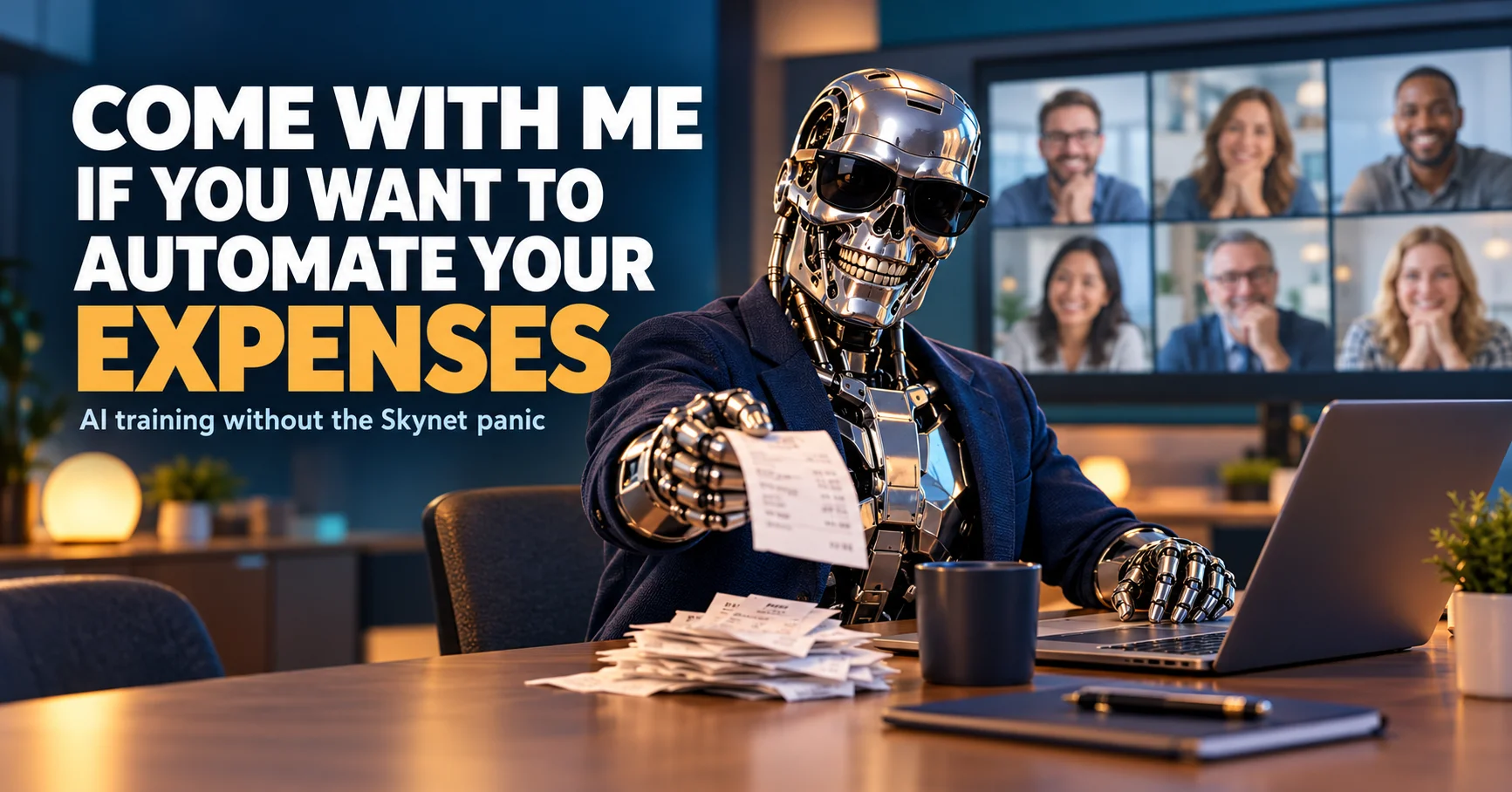
Ten questions from the AI training room, including the inevitable one about Skynet.
Working in digital transformation and AI means I regularly deliver training over Zoom, Microsoft Teams and Slack Huddles. Occasionally, I even appear in person, provided the client is prepared to put me up in a decent hotel.
I am enthusiastic about the future. I am less enthusiastic about a mattress that remembers the last three guests.
Whatever the setting, the questions tend to follow a familiar pattern. Someone wants to save time. Someone wants to know whether their data is safe. Someone has been sent by their manager and would prefer to be literally anywhere else.
And somewhere in the room, a person is waiting.
They have heard “artificial intelligence”. They have mentally located their copy of Terminator 2. They are preparing to make a contribution.
“Isn’t this how Skynet starts?”
There it is. We can begin.
Underneath the jokes, though, people have reasonable concerns. Their livelihoods, confidence, privacy and professional pride are involved. If your introduction to AI consists of headlines promising either unlimited prosperity or the extinction of humanity, being slightly apprehensive seems fair.
My job is to make it understandable and useful, with enough humour that nobody feels they have accidentally joined a procurement presentation.
Here are ten questions that keep coming back.
1. “Will AI take my job?”
The fear is straightforward: on Monday you are training the AI. By Friday, it is organising your leaving do.
I could say, “AI won’t replace you. Someone using AI will.” It is catchy. It also sounds suspiciously like a threat when delivered to someone worried about paying their mortgage.
The more honest answer is that AI can automate parts of jobs, change others and, in some cases, contribute to jobs disappearing. Nobody delivering a seminar can responsibly guarantee otherwise.
But a job is usually a bundle of tasks. Writing the first draft of a report is one task. Knowing whether that report makes sense, understanding the client and dealing with the consequences are others.
The ILO’s 2025 research identifies job transformation as the likelier overall effect of generative AI, because most occupations still contain tasks requiring human input. Source: ILO
The useful conversation is: which parts of your work could improve, what training will you receive, and what will management do with the time saved?
If the answer to that last question is “give you another twenty tasks”, your concern may be less about artificial intelligence and more about the management of human resources.
2. “I’m not a tech person. Isn’t this too complicated?”
Apparently, using AI requires a PhD, three monitors and a hoodie worn indoors regardless of temperature.
For everyday uses, the starting point is much simpler: explain what you need.
“Turn these notes into a polite email.”
“Explain this document without assuming I already understand it.”
“Help me prepare for this meeting.”
You do not need to learn programming before trying those things. You do need practice, a suitable tool and some judgement about what to share and whether the answer is useful.
The skill develops when you add context: who the email is for, what you want to achieve, what the document means to your work, or why the meeting might become a diplomatic incident.
Asking “write me something good” is a bit like telling a taxi driver “take me somewhere nice”. You may get a result, but you could end up in Sunderland.
Start with one small, familiar task. You do not have to transform your entire working life before lunch.
3. “It makes things up!”
Yes. Sometimes impressively.
An AI system can produce an answer with the confidence of a man explaining your own job to you at a barbecue.
It can invent a quotation, misread a document or cite research that turns out to exist exclusively in its imagination. Fluent wording does not establish truth.
Think of it as a very capable assistant whose work still needs checking. The comparison with an enthusiastic intern is useful, provided we remember that software does not acquire professional judgement merely because we give it a friendly name.
For factual work, check important claims against reliable original sources. If a tool supplies citations, open them and confirm they actually support the answer. A blue link is not a certificate of reality.
In a training session, a mistake can become one of the most useful demonstrations: here is what went wrong, here is how we spotted it, and here is how we correct it.
Besides, Uncle Bob has been confidently inventing facts at Christmas dinner for thirty years. We still invite him. We just check before repeating his medical advice.
4. “What happens to my data?”
This question deserves more than “don’t worry about it”.
You should know which tool your organisation approves, what information you may enter, how it is stored and who can access it.
Different products and plans have different terms. For example, OpenAI says it does not use business product inputs and outputs for model training by default. That is a specific policy, not a universal promise about everything with “AI” on the box. Source: OpenAI
And “not used for training” does not automatically mean “never stored”, “never processed by another provider” or “approved for your client’s confidential information”.
Use the approved service. Understand the rules. Practise with invented or properly anonymised examples where appropriate.
If a demonstration needs a fictional customer, give me “Dave Example” and an imaginary invoice. We do not need the actual Dave’s bank details to demonstrate how a summary works.
Dave has suffered enough. We are already using his spreadsheet in section one.
5. “Isn’t this how Skynet starts?”
We have reached the moment someone has been waiting for.
I understand it. Popular culture has spent decades preparing us for AI by showing us machines that become self-aware and immediately develop a very poor attitude towards customer retention.
But a chatbot producing a draft email is a rather different proposition from a fictional military system controlling weapons.
That does not make real AI risks imaginary. Errors, scams, misuse, security failures and systems being given excessive access all deserve attention. A tool does not need to become conscious to cause trouble; being wrong while allowed to do too much can be quite sufficient.
That is why permissions matter. An assistant allowed to draft an email is different from one allowed to send it, delete the customer records and authorise a payment.
Start with limited access and clear checks. Increase responsibility only when there is a reason and the system has earned it through testing.
Before granting an AI control of critical infrastructure, perhaps establish whether it can reliably handle the office stationery order.
Judgement Day can wait. We are out of envelopes.
6. “Won’t it make us lazy and stupid?”
It can encourage lazy habits if we let it.
I am not going to pretend that copying an answer without reading it is suddenly professional development because the answer arrived through an expensive subscription.
There is a meaningful difference between “do my thinking for me” and “help me think this through”.
Ask it to challenge your argument, explain an unfamiliar concept, question your assumptions or help you practise a skill. Then engage with the answer.
Or let it produce a document you do not understand, attach your name and discover what happens when someone asks a follow-up question.
Only one of these is a sensible learning strategy.
Calculators are useful. So is knowing when the answer on the calculator is complete nonsense. AI deserves the same habit of attention.
And if you teach this stuff, ask learners to explain why they accepted or rejected an answer. That tells you much more than whether they successfully located the copy button.
7. “It has no feelings. What about human connection?”
Nobody wants to ring a service in distress and spend twenty minutes arguing with Brenda-Bot 3000 before being told their feelings are important and the chat has ended.
People are right to object when organisations use automation to make human help harder to reach.
But there is another possibility: use AI to reduce administrative work so people have more time for actual conversations.
That benefit depends on how the organisation uses the time. An AI tool cannot promise that a manager will reinvest it in better care, better teaching or better customer service.
Humans have to make that choice.
For someone who struggles to express themselves in writing, AI can also help put their own thoughts into clearer words. Assistance with wording does not mean the thoughts stopped belonging to them.
Sometimes technology helps a person feel heard.
The T-800 was famously committed to completing its assignment. I still would not choose it to deliver sensitive feedback over a cup of tea.
8. “It’s biased.”
Yes, AI can reproduce or amplify unfair patterns. That is a reason to test and question it, particularly when decisions affect people’s opportunities.
The answer cannot simply be, “Humans are biased too.”
Humans are biased too. Putting the bias through a server does not improve it.
A system might repeat stereotypes, perform unevenly across groups or produce different recommendations for reasons that should have nothing to do with the decision.
You can run structured tests and compare results, but identifying and reducing bias takes more than asking the chatbot whether it considers itself fair.
The same scepticism should apply to the hiring manager who “just had a good feeling” about the applicant who supports Arsenal.
Ask what evidence supports the recommendation. Ask who might be disadvantaged. Make sure someone can challenge an outcome.
“Computer says no” was a comedy sketch. It should not become the entire appeals process.
9. “Who’s responsible when it goes wrong?”
“ChatGPT told me to” is not a management strategy.
Responsibility needs to be clear before a system is used: who approves the use, who checks its work, who can stop it, and who deals with a mistake.
The exact legal position depends on the situation. Operationally, though, an organisation needs named people who own the process. A software subscription cannot attend the difficult client meeting on your behalf.
Human oversight also needs to mean something. A person clicking “approve” on two hundred recommendations they have neither time nor information to assess is providing decorative supervision.
Give people the knowledge, time and authority to disagree.
I use the phrase “AI colleagues”, including systems that can work with other systems. But a friendly title does not remove the need for boundaries, monitoring and human responsibility.
If anything, the more your software can do, the more clearly you need to define what it is allowed to do.
Cyberdyne could have benefited from a slightly more thorough permissions review.
10. “It’s just hype. Remember NFTs?”
I do remember.
For a while, it appeared the future of commerce depended on persuading people to remortgage their house for a picture of a disappointed donkey.
There is plenty of AI hype too. Some products are useful. Some are an ordinary feature wearing an “AI-powered” badge and charging extra.
You are allowed to ask whether it solves a real problem.
Does it improve the work? Does it save time after checking and correction? Does it justify the cost? Can the people expected to use it actually use it?
Those questions are far more useful than either “everything must have AI” or “everything involving AI is regurgitated slop”.
Try a defined task, agree what success would look like and compare the result with your existing approach.
If a tool helps you turn chaotic notes into a usable first draft, that is a benefit you can examine. If it produces forty pages you must spend the afternoon repairing, it has only automated the creation of additional work.
We had meetings for that already.
A word for the person delivering the training
The person asking difficult questions is not necessarily the problem in the room.
Sometimes they are the only person willing to ask what everyone else is thinking.
If someone worries about their job, telling them to “embrace disruption” is unlikely to help. Disruption sounds exciting when you are selling consultancy. It sounds less exciting when it might interrupt your salary.
Acknowledge the concern. Demonstrate something relevant to their work. Use safe examples. Let people question the answer and see you correct it.
Do not make the least confident person perform a live demonstration in front of everyone. We are trying to introduce useful software, not recreate their school French oral exam.
And if you manage the team, give them time to learn during working hours. Announcing an AI strategy and expecting everyone to acquire the skills on Sunday evening is an ambitious interpretation of staff development.
Good training should leave people more capable and better able to judge when a tool helps, when it fails and when they should ask for support.
You do not have to love AI to learn it
You can be sceptical and still be curious. You can use AI for one useful task without declaring allegiance to the machines.
You can also decide that a particular tool is unsuitable. Learning enough to make that judgement is a successful outcome.
What matters to me is that people leave with a little more confidence, a clearer understanding of the risks and something practical they can try.
Ideally, they also leave knowing that their questions were welcome. Even the Skynet one.
Then, at the end of the seminar, I put on my best Terminator voice and deliver the line:
“Come with me if you want to automate your expenses.”
I cannot promise to save humanity.
But we might finally get your mileage claim submitted.