
Guernsey's Minimum Wage: Enough to Work, But Not Enough to Live?
Guernsey's minimum wage is now £13.10 an hour, but is that enough to afford somewhere to live? I break down the real numbers, from tax and rent to groceries and everyday expenses, and ask what GST could mean for people already struggling to make ends meet.
Published 13 Oct 2026, 00:12 BST · Last edited 13 Oct 2026, 23:47 BSTShare this page ↗
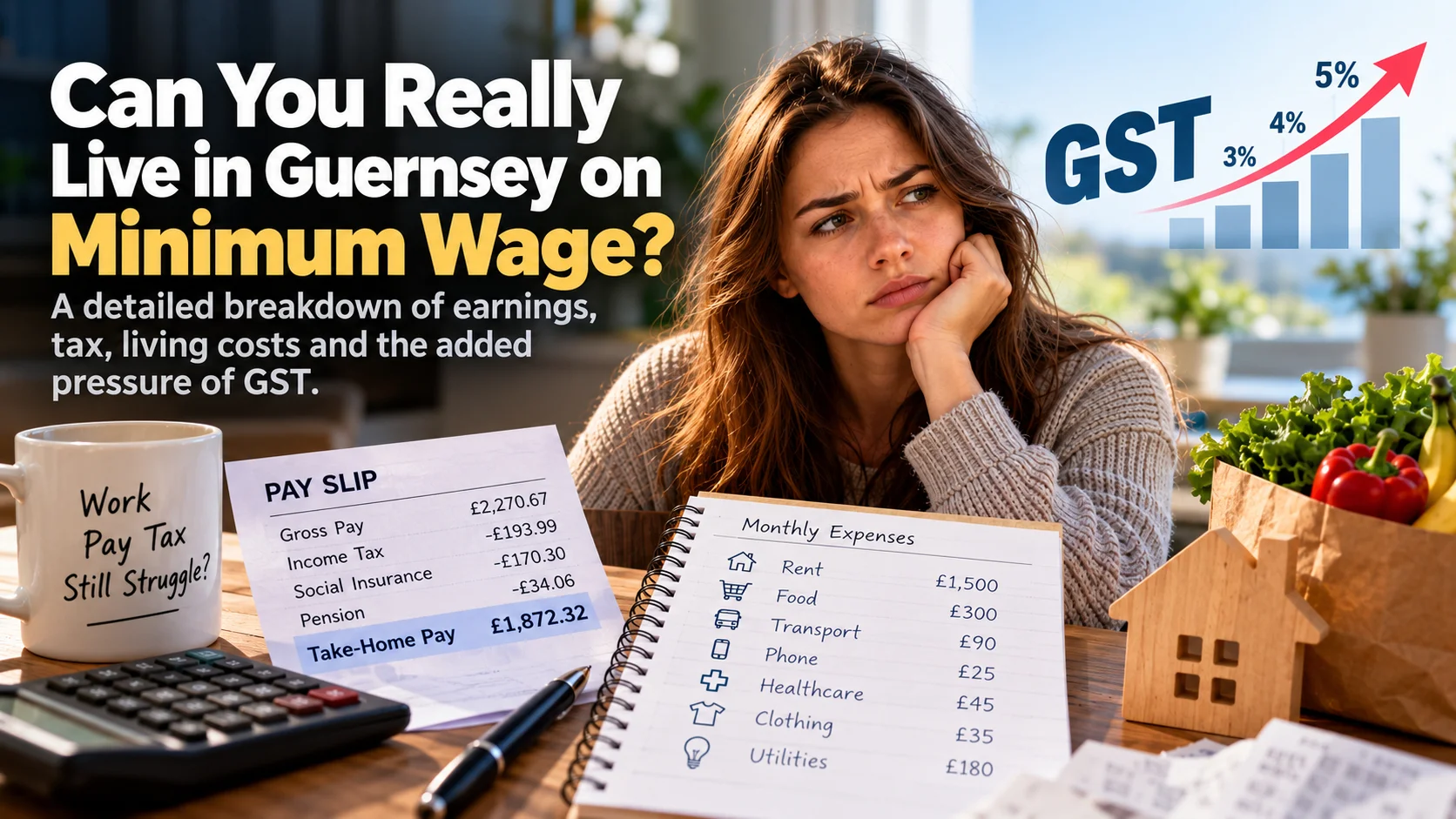 Guernsey's Minimum Wage: Enough to Work, But Not Enough to Live?
An examination of what someone earning Guernsey's minimum wage actually takes home, what it costs to keep a roof over their head, and why the introduction of GST raises further questions about affordability.
There's something fundamentally troubling about the idea that someone can work 40 hours a week, contribute to society, pay their taxes and social insurance, and still struggle to afford somewhere to live.
Yet, when you examine Guernsey's minimum wage alongside the island's cost of living, that is precisely the situation many workers could find themselves in.
And with the States having approved the introduction of Goods and Services Tax (GST), the question becomes even more important.
Are we paying people enough to live, or simply enough to keep working?
Let's look at the numbers.
Updated 13 October 2026: Following some valuable observations from Deputy Rob Curgenven, I've added a brief section exploring the proposed GST mitigations and whether they'll genuinely protect households from rising living costs. My thanks to Rob for allowing me to share his thoughts and link to his supporting research.
The Minimum Wage in Guernsey
On 1 October 2026, Guernsey's statutory minimum wage increased to:
- £13.10 per hour for adults aged 18 and over.
- £11.80 per hour for young people aged 16 and 17.
These rates were approved under the Minimum Wage (Guernsey) Law, 2009.
On paper, £13.10 an hour might sound reasonable. It is certainly an improvement on previous rates.
But hourly wages mean very little until we calculate what someone actually takes home and, more importantly, what they have left after paying for life's necessities.
For this exercise, we're going to look at a single adult working 40 hours a week on minimum wage.
No children, no dependants, no expensive lifestyle and no extravagant spending habits.
Just someone trying to support themselves.
What Does a Full-Time Minimum Wage Worker Actually Earn?
At £13.10 per hour, working 40 hours a week:
| Earnings | Amount |
|---|---|
| Hourly wage | £13.10 |
| Weekly gross pay | £524.00 |
| Monthly gross pay | £2,270.67 |
| Annual gross salary | £27,248.00 |
Not too bad, perhaps?
Unfortunately, that's before the deductions.
Using Guernsey's 2026 income tax allowance of £15,200, the standard 20% income tax rate, employee social insurance of 7.5%, and the 1.5% minimum employee secondary pension contribution, the calculations look like this:
| Monthly deductions | Amount |
|---|---|
| Gross monthly salary | £2,270.67 |
| Income tax | -£193.99 |
| Social insurance | -£170.30 |
| Employee pension | -£34.06 |
| Actual take-home pay | £1,872.32 |
The income tax calculation includes relief for the employee's pension contribution.
That's approximately £1,872 a month to pay for absolutely everything.
Someone working a more typical 37.5-hour week would take home approximately £1,771 instead.
These figures assume a full year's employment, standard allowances and no additional income or deductions. Individual circumstances may differ.
Now comes the uncomfortable part.
Finding Somewhere to Live
Housing is arguably Guernsey's biggest affordability challenge.
According to the island's second-quarter 2026 property statistics, the mix-adjusted average Local Market monthly rent reached £2,138.
That's an average across rented properties, not specifically one-bedroom flats, but it provides some perspective on the housing market.
For somebody earning £1,872 a month after deductions, the average monthly rent is already higher than their entire income.
Before eating.
Before heating.
Before electricity.
Before anything else.
Of course, a single person doesn't necessarily need an average-sized property. So let's examine two more modest possibilities.
A room in shared accommodation advertised for £990 per month, including bills, and a one-bedroom apartment advertised for £1,500 per month.
Both are based on actual Guernsey property advertisements, although availability and individual tenancy conditions can change.
Scenario One: Renting a Room
Let's assume our minimum-wage worker manages to secure a room for £990 a month, including utilities.
Here's a fairly conservative estimate of their monthly living expenses.
| Monthly expense | Cost |
|---|---|
| Room rental, including bills | £990 |
| Food and groceries | £300 |
| Transport | £90 |
| Mobile phone | £25 |
| Medical and dental allowance | £45 |
| Toiletries and personal care | £35 |
| Clothing and footwear | £35 |
| Household essentials | £25 |
| Emergency savings | £80 |
| Total monthly expenditure | £1,625 |
With a take-home salary of £1,872, that leaves:
£247 per month.
Or approximately £57 per week.
That's the money left for everything that wasn't included in the budget.
A birthday present. Replacing a broken phone. Visiting family. An unexpected medical appointment. A prescription. A pair of shoes.
Perhaps even having a little fun occasionally.
And remember, our worker is already spending more than half their take-home salary simply renting a room.
There is very little flexibility.
If that room costs £1,200 rather than £990, their remaining monthly surplus falls to just £37.
One unexpected expense could wipe that out immediately.
This isn't financial security. It's financial survival.
Scenario Two: Renting a One-Bedroom Flat
Now let's assume our worker wants something many people consider perfectly reasonable.
A place of their own.
Nothing luxurious. Just a modest one-bedroom apartment costing £1,500 a month.
Here's how that budget might look.
| Monthly expense | Cost |
|---|---|
| Rent | £1,500 |
| Electricity, heating, water and other utilities | £180 |
| Food and groceries | £300 |
| Transport | £90 |
| Mobile phone | £25 |
| Medical and dental allowance | £45 |
| Toiletries and personal care | £35 |
| Clothing and footwear | £35 |
| Household expenses and insurance | £45 |
| Emergency savings | £85 |
| Total monthly expenditure | £2,340 |
Monthly take-home salary: £1,872
Monthly expenditure: £2,340
Monthly shortfall: £468.
That's a deficit of approximately £5,612 every year.
And let's not pretend this is an extravagant budget.
There's no car finance, expensive holidays, luxury shopping or regular restaurant visits.
We've allowed just £45 a month for medical and dental expenses, despite Guernsey residents generally having to pay for GP appointments.
We've allowed £85 for emergencies, which could disappear with one unexpected bill.
We've also assumed a relatively modest £180 for utilities, which may not be sufficient during colder months.
Even without these additional pressures, the numbers simply don't work.
Someone earning the legal minimum wage cannot realistically afford this modest apartment and cover their basic living expenses from their wages alone.
They would need a partner, a second income, financial assistance or some other form of support.
And that raises a fairly obvious question.
Why should someone working full-time need a second income simply to afford somewhere to live?
These are illustrative budgets rather than official minimum-living-cost calculations. They exclude any Income Support or housing assistance for which an individual might qualify. Actual costs will vary.
And Now We're Introducing GST
On 2 October 2026, the States of Guernsey voted by 22 to 17 to approve its tax reform package.
This includes the introduction of a broad-based GST, currently planned to begin in 2029.
The approved framework sets out the following progression:
| Planned period | GST rate |
|---|---|
| Initial introduction, currently planned for 2029 | 3% |
| Approximately two years later | 4% |
| Approximately four years after introduction | 5% |
The later increases are subject to further review and conditions. They are not necessarily automatic.
The package also includes reductions in income tax and changes to social insurance contributions designed to offset some of the impact.
This distinction matters.
It would be misleading to calculate someone's disposable income using today's tax rates, add GST to their expenditure and claim that represents their exact financial position in 2029.
The Government argues that its accompanying tax reductions, increases to certain benefits and an Essentials Cost Relief Payment will protect lower-income households.
Those measures deserve to be acknowledged.
Indeed, the States has stipulated that the relevant financial protections must be operational before GST can begin.
But that doesn't mean concerns about affordability simply disappear.
What Will GST Mean at the Checkout?
For illustration, let's assume someone spends £600 per month on goods and services that become subject to GST.
If the tax is passed on fully to consumers, the additional cost would be:
| GST rate | Additional monthly cost | Additional annual cost |
|---|---|---|
| 3% | £18 | £216 |
| 4% | £24 | £288 |
| 5% | £30 | £360 |
For somebody comfortably earning £60,000 or £80,000 a year, those amounts might appear relatively insignificant.
But for somebody already calculating whether they can afford their shopping, every pound matters.
And the effects are not necessarily confined to the checkout.
Businesses may face additional administration and compliance costs. Some could adjust their prices to recover those expenses.
That doesn't mean every business will increase prices or that every product will rise by more than the headline GST rate. It does mean there are potential indirect costs worth considering.
Residential rents are not intended to attract GST directly, but landlords may experience changes in their own costs, and wider inflation could eventually influence rental prices.
We should also remember that the planned GST is broad-based and includes ordinary food purchases, although the States approved zero-rating for food produced or grown by qualifying small independent suppliers.
For households already struggling, this is particularly relevant.
Food isn't a luxury.
Neither are clothes, heating or basic household necessities.
You cannot choose to stop eating because the Government needs additional revenue.
But Won't the Tax Reductions Make People Better Off?
Possibly. And for some households, quite substantially.
The approved package includes a lower 15% income tax rate on an initial band of taxable income, alongside a new allowance against social insurance contributions.
These measures could reduce deductions from a minimum-wage worker's salary.
There are also targeted support arrangements for qualifying lower-income households.
Consequently, it would be wrong to suggest that every minimum-wage worker must automatically be worse off after GST is introduced.
Some may be financially better off overall.
Others may experience different outcomes depending on their earnings, housing circumstances, household composition, eligibility for support and spending patterns.
The difficulty is that the precise outcome for a particular household depends on how all those measures interact when the reforms actually begin.
And there is a much bigger issue.
Even if the tax reforms put another £50 or £100 into somebody's pocket each month, how does that solve a housing affordability problem measured in hundreds of pounds?
If someone is already £468 short every month, relatively modest tax savings will not necessarily make independent living affordable.
This is why I believe the entire conversation needs to go beyond whether GST leaves the average household a few pounds better or worse off.
We need to ask whether people's incomes actually reflect the cost of living in Guernsey.
Are the GST Mitigations Really Enough?
Following publication of this article, Deputy Rob Curgenven raised some important observations about the Government's proposed GST mitigations. He also kindly shared several articles he's written for The People's Trust Guernsey, examining the assumptions and financial modelling behind the reforms.
Rob raises a particularly important question: Will the promised financial protections actually make households better off in the real world, rather than simply on paper?
His concerns include rising rents, wage inflation, changes in consumer spending and the additional administrative costs businesses may pass on to customers. With GST not expected until 2029, how confident can we be that today's calculations will reflect tomorrow's cost of living?
Interestingly, the Government has already revised its estimated annual GST revenue from household spending downwards, from £41 million to £38.3 million. An independent review subsequently supported the revised figure, but did not assess the overall impact of the complete tax package on different household groups.
As Rob succinctly put it:
"None of this means the figures are necessarily wrong, but the assumptions behind them should be published and stress-tested before anyone is told they’ll be better off."
Deputy Rob Curgenven
And I couldn't agree more.
Being £100 better off on paper means very little if you're still £400 short of paying your monthly bills.
My thanks to Rob for his contribution and permission to quote him. His articles, including Getting the (GST) Numbers Right and Before We Ask Islanders to Trust the Numbers, We Should See the Workings, are well worth reading.
Anyway, back to wages!
What About Employer-Provided Accommodation?
There's another interesting provision within Guernsey's minimum wage legislation.
Employers who provide accommodation can count a prescribed value towards meeting the minimum wage requirements.
From October 2026, those offsets are:
- Accommodation only: £118 per week.
- Accommodation and food: £164 per week.
These are not limits on what landlords can charge for accommodation.
They represent the maximum prescribed weekly values that can be treated as remuneration under the minimum wage rules.
In monthly terms, they equate to approximately £511 for accommodation alone or £711 for accommodation and meals.
This arrangement may help some employers provide accommodation, particularly in industries dependent on seasonal or imported labour.
But it also highlights how closely employment and housing can become connected.
For somebody whose accommodation is linked to their job, losing that job can potentially mean losing both their income and their home.
That is a particularly vulnerable position.
What About Families?
So far, we've considered somebody with relatively few financial responsibilities.
A single adult.
No children.
No childcare.
No dependants.
No vehicle finance.
No significant debt.
No unexpected medical conditions.
Now imagine that same worker has a child.
Or two.
Imagine needing a larger property, paying for childcare, purchasing school uniforms, replacing children's shoes and covering the countless expenses associated with raising a family.
Or imagine being a single parent trying to balance employment with those responsibilities.
The financial pressure increases dramatically.
Yes, Guernsey has Income Support and social housing arrangements for eligible households.
These are important safety nets.
But the existence of financial assistance does not remove the underlying question of whether employment pays enough to meet the cost of living.
And not everyone will qualify for the same assistance.
Residency status, household circumstances, savings and income can all influence eligibility.
A person who falls outside the support system may have very few alternatives.
The Difference Between a Minimum Wage and a Living Wage
This is where I think our political conversation needs to change.
A minimum wage is a legal requirement.
It establishes the lowest hourly rate an employer can generally pay an eligible worker.
A living wage is a different concept.
It considers what someone actually needs to earn to maintain a reasonable standard of living.
Not a luxurious lifestyle.
Not expensive holidays or designer clothes.
Just somewhere safe to live, food on the table, the ability to pay bills and a little financial resilience when something inevitably goes wrong.
Those two figures are not necessarily the same.
And in Guernsey, the gap between them appears substantial.
Consider our example again.
A worker earning £13.10 per hour takes home approximately £1,872 per month.
Renting a modest one-bedroom apartment and covering basic expenses requires approximately £2,340.
To afford that lifestyle without financial assistance, using the same 2026 tax and pension assumptions, the worker would need to earn roughly £16.90 an hour.
That's approximately 29% above the legal minimum wage.
And even then, our hypothetical budget contains very little room for a genuinely comfortable life.
It merely balances the books.
Is Guernsey Becoming an Island Where Working Isn't Enough?
Guernsey is an extraordinary place.
It's an island with a strong community, a beautiful environment and significant economic opportunities.
But those qualities mean very little to someone who cannot afford to remain there.
We regularly hear discussions about labour shortages, recruitment difficulties, the rising cost of housing and businesses struggling to attract staff.
Perhaps these issues are more closely connected than we sometimes acknowledge.
If someone can work full-time and still be unable to afford independent accommodation, what incentive is there for them to remain?
How do young islanders establish independence?
How do people save for deposits?
How do families plan for their futures?
And how do employers recruit and retain workers when the cost of living places such enormous pressure on wages?
These aren't separate problems.
They're interconnected parts of the same affordability challenge.
Increasing the minimum wage helps, but if housing and other essential costs continue rising faster than incomes, the benefit can quickly disappear.
Likewise, introducing GST alongside compensating tax reductions may alter household finances, but it doesn't automatically resolve the structural problem of unaffordable housing.
The Question Our Deputies Should Be Asking
I appreciate that governments need revenue.
Public services cost money, healthcare is increasingly expensive, and Guernsey faces genuine long-term financial challenges.
Those concerns shouldn't be dismissed.
But neither should the circumstances of the people expected to fund those services.
Before celebrating minimum wage increases, we should ask whether the resulting income is sufficient.
Before introducing additional consumption taxes, we should examine what households actually spend and how the proposed protections affect different income groups.
And before claiming that people will be financially better off, we should publish clear, understandable calculations showing exactly how those conclusions were reached.
Not just theoretical averages.
Realistic examples.
- A single worker on minimum wage.
- A young couple renting their first home.
- A single parent.
- A pensioner.
- A household where one person works full-time and another provides unpaid care.
Show their income.
Show their deductions.
Show their housing costs.
Show their essential expenditure.
Then show precisely how the tax reforms affect them.
Because percentages, averages and financial models are considerably less reassuring when your bank balance is approaching zero.
Final Thoughts: Surviving Isn't Living
Our example isn't about someone refusing to work or expecting the Government to provide a luxurious lifestyle.
It's about someone who gets up every morning, works a full week, pays their taxes and contributes to the island's economy.
Yet their income may still be insufficient to rent a modest home independently.
Sharing accommodation might make survival possible, but even then, financial security can remain painfully out of reach.
And while the proposed GST reforms include measures intended to protect lower earners, the fundamental affordability problem will remain unless wages, housing costs and living expenses are addressed together.
For me, the most concerning part isn't simply that somebody on minimum wage might struggle to make ends meet.
It's that we've reached a point where working full-time no longer necessarily provides the financial independence that previous generations often took for granted.
A minimum wage should provide more than the minimum opportunity to survive.
It should offer a realistic route towards stability, independence and a reasonable quality of life.
Because if somebody can work 40 hours a week and still cannot afford somewhere modest to live, we shouldn't simply be asking whether they're managing their money correctly.
We should be asking whether the numbers themselves are fundamentally wrong.
And with GST on the horizon, that question deserves an answer sooner rather than later.
Sources and Calculation Notes
The following sources were used for the factual information and illustrative calculations in this article.
- Guernsey Parliament: Minimum Wage Amendments 2026 - Adult and young-person minimum wage rates from 1 October 2026.
- PwC: Guernsey Individual Taxation - 2026 income tax allowance, tax rates and social insurance changes.
- Your Island Pension: Contribution Rates - Minimum employee pension contributions for 2026.
- Guernsey Press: Q2 2026 Property Market - Average Local Market rent of £2,138 per month.
- SpareRoom: Guernsey Room Rental - Example of a room advertised at £990 including bills.
- Livingroom: One-Bedroom Guernsey Apartment - Example of a one-bedroom Local Market apartment advertised at £1,500 monthly.
- Guernsey Parliament: Tax Reform 2026 - Approved tax reform framework and amendments.
- Official Voting Record: Tax Reform 2026 - Final approval on 2 October 2026 and GST implementation safeguards.
Important: All wages, tax calculations and illustrative living-cost budgets use October 2026 values. GST projections are illustrative and do not constitute forecasts of the net financial effects of the reforms in 2029 or subsequent years. Rental listings are examples rather than a representative survey of available properties.