
Jurassic Island or AI Island? Guernsey's Future Is a Choice
Guernsey stands at a technological crossroads. AI could transform finance, government, employment and public services, freeing people to tackle the island's biggest challenges. But with a history of failed IT projects and questionable accountability, will Guernsey embrace the opportunity to become a global frontrunner, or risk becoming a Jurassic Island?
Published 23 Oct 2026, 00:00 BST · Last edited 23 Oct 2026, 00:00 BSTShare this page ↗
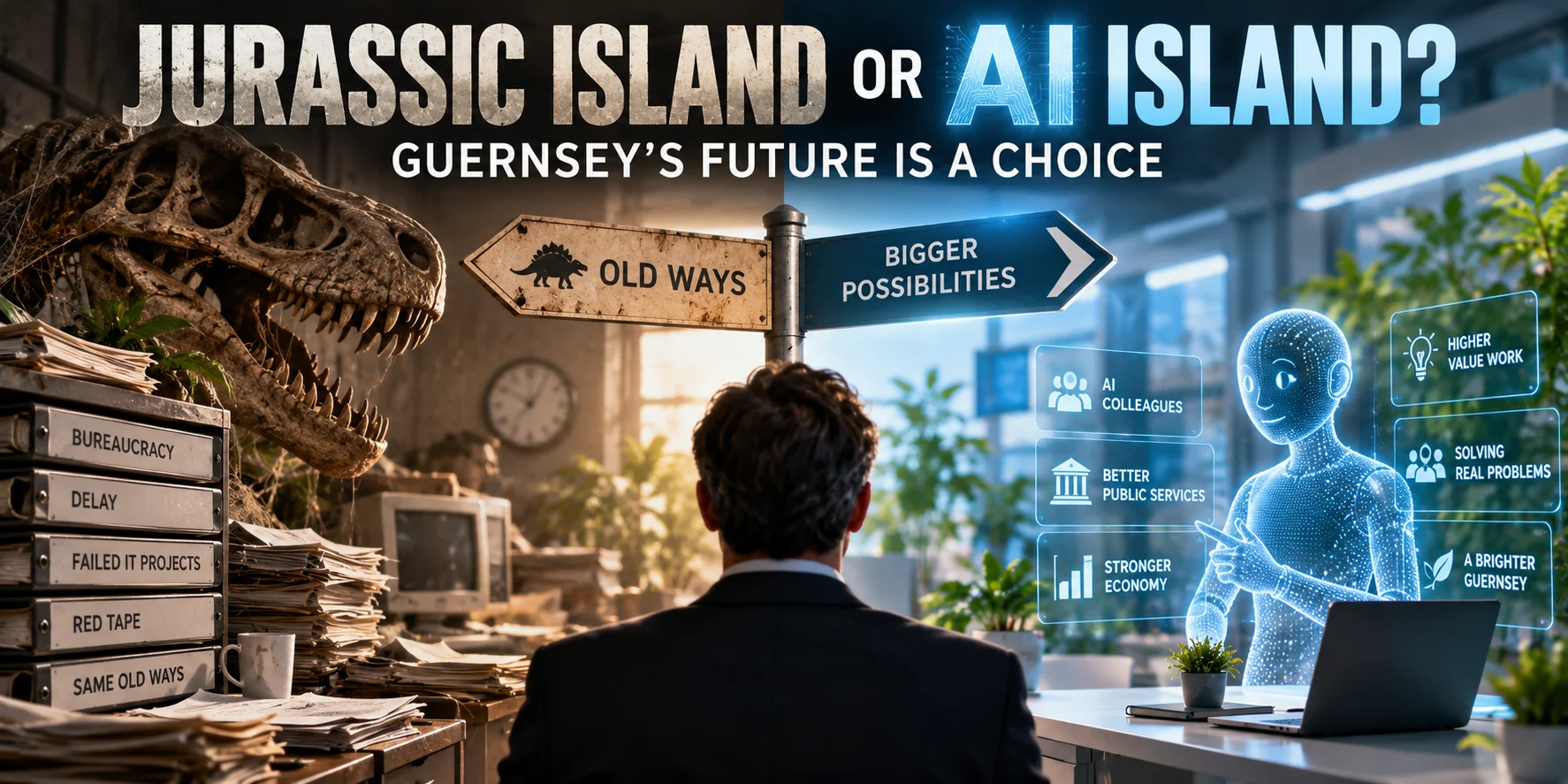
Artificial intelligence is transforming the global economy. For Guernsey, the greatest threat may not be the technology itself, but our failure to embrace it. The island has an extraordinary opportunity to reinvent how we work, deliver public services and compete internationally. But first, we need to leave some prehistoric thinking behind.
The world is changing. Is Guernsey changing with it?
Imagine a future where Guernsey's civil servants spend less time processing paperwork and more time helping islanders.
Where financial professionals concentrate on building relationships, identifying opportunities and providing specialist advice rather than spending countless hours reconciling spreadsheets.
Where lawyers spend more time helping clients and resolving disputes instead of searching through thousands of documents.
Where healthcare professionals have more time for patients, teachers have more time for pupils, and government has more time to tackle the challenges facing our island.
Imagine planning applications being processed more efficiently, government departments sharing information securely, and islanders no longer having to explain the same problem repeatedly to different people.
Now imagine something else.
Guernsey decides that artificial intelligence is not worth the investment, that existing systems are good enough, and that maintaining traditional working practices is somehow a competitive advantage.
Meanwhile, competing jurisdictions transform their economies, dramatically improve productivity and attract the businesses, investment and skilled professionals that Guernsey needs.
Welcome to the crossroads between Jurassic Island and AI Island.
The technology is already here. The question is whether Guernsey intends to help shape its future or spend the next decade catching up.
And for an island with a relatively small population, limited resources and an economy heavily dependent on financial and professional services, that decision could be enormously consequential.
Let's talk about the elephant in the room: jobs
Whenever artificial intelligence is mentioned, one question inevitably dominates the conversation:
Is AI going to take our jobs?
It's an understandable concern, but perhaps we're asking the wrong question.
What if we asked something different?
What could people achieve if we gave them back the time currently consumed by repetitive, administrative and inefficient processes?
Of course, we shouldn't pretend that technological disruption is painless. Some jobs will disappear, others will change considerably, and entirely new occupations will emerge.
Employers may eventually need fewer people to perform tasks. Entry-level positions could become harder to obtain, and people without opportunities to retrain could find themselves disadvantaged.
Those risks are real and deserve serious consideration.
However, the relationship between technological advancement and employment has never been as simple as one machine replacing one person.
Throughout history, innovation has transformed the nature of work.
Computers didn't eliminate accountants. They changed accounting.
Spreadsheets didn't eliminate financial analysts. They transformed financial analysis.
The internet didn't eliminate commerce. It created entirely new industries.
Artificial intelligence represents another transformation, although its reach into professional and knowledge-based work could be considerably greater.
In 2025, the International Labour Organization reported that approximately one in four jobs worldwide had some exposure to generative AI. Its conclusion was that transformation, rather than outright replacement, remained the most likely outcome for most occupations.
A subsequent review published in June 2026 also found that productivity gains were uneven and that large-scale displacement remained limited, while warning about risks to younger workers and inequality.
Source: International Labour Organization: One in four jobs at risk of being transformed by generative AI
The important lesson is that technology alone does not determine the outcome.
The decisions made by governments, employers, educators and workers determine who benefits.
The objective should not simply be to employ fewer people. It should be to enable people to do more valuable, rewarding and productive work.
Guernsey's employment landscape: the numbers behind the challenge
Before examining individual industries, it's worth understanding the scale of the potential transformation.
According to the States of Guernsey's published employment statistics, approximately 32,067 people were employed or self-employed in June 2024.
Of those, 28,909 were employed by businesses or organisations, while 3,158 were self-employed.
Financial services, together with legal and accounting activities, accounted for approximately 22.9% of employment roles. This represents a substantial concentration of work involving financial information, documentation, administration, analysis and regulatory compliance.
These are precisely the types of activities increasingly affected by AI and automation.
The financial and insurance sector also contributed approximately £1.3 billion, or 37% of Guernsey's GDP, in 2023. Including legal and accounting activities increased the contribution to approximately 44%.
In other words, close to half of the island's economic output was connected to industries likely to experience significant technological transformation.
Source: States of Guernsey: Population and employment statistics
Public administration and government employment represent another major opportunity.
Figures reported from the States' 2025 accounts show that its core workforce increased to approximately 5,298 full-time-equivalent posts, while employment across the wider States group reached 6,775 posts.
These figures include substantial numbers of frontline workers, including healthcare professionals and teachers, whose work cannot be replaced by software. They should not be confused with the narrower industrial classification of public administration.
Source: Guernsey Press: States core staff numbers increased in 2025
The warning we've already been given
In July 2020, PwC published its report, Upskilling the Channel Islands' Workforce for a Digital World.
It estimated that approximately 32% of Guernsey's jobs, representing around 10,800 roles, could be at risk from automation by 2035.
The report identified financial services as particularly exposed and emphasised the importance of retraining, digital skills and workforce transformation.
Crucially, these figures represented potential employment disruption under a predictive model, not a guarantee that 10,800 people would lose their jobs.
The report also acknowledged the opportunity to create new employment through digital transformation.
Its analysis predates the rapid development of modern generative and agentic AI, so its precise forecasts should not be treated as current predictions. Nevertheless, the underlying warning remains relevant.
Source: PwC: Upskilling the Channel Islands' Workforce for a Digital World (PDF)
More recent research strengthens the argument for preparation.
In July 2026, PwC's Channel Islands analysis identified the increasing importance of AI skills, suggesting that some professional roles are becoming more specialised while others are being reshaped as technology takes over complex tasks.
It also reported that approximately 85% of Channel Islands companies surveyed at the end of 2025 considered access to AI expertise insufficient.
That is a skills challenge, but also an economic opportunity.
Source: PwC: AI Jobs Barometer
Which industries could benefit most?
Rather than attempting to predict how many employees will lose their jobs, a more constructive approach is to examine which activities are likely to change.
The following assessment considers Guernsey's principal employment sectors and the opportunities for redirecting human effort.
If you're viewing this on a mobile device, you may need to swipe left to see the full table.
| Industry | Potential AI impact | What people could concentrate on instead |
|---|---|---|
| Financial services and banking | Very high for administrative and analytical tasks | Client relationships, financial strategy, complex risk assessment and innovation |
| Trust and fund administration | Very high for documentation and routine processing | Bespoke client services, specialist oversight and business development |
| Legal services | High for research and document-heavy work | Legal strategy, advocacy, negotiation and client care |
| Accounting and audit | High for reconciliation, reporting and routine analysis | Financial advice, complex assurance, business consultancy and strategic planning |
| Government and civil service | High for repetitive administration | Better public services, policy development, infrastructure planning and problem-solving |
| Insurance and compliance | High for information processing and monitoring | Complex investigations, specialist underwriting and regulatory judgement |
| Healthcare and social care | High for administrative support; lower for direct personal care | Patient interaction, personalised treatment and compassionate care |
| Education | High for preparation and administrative support | Individual teaching, mentoring and additional educational support |
| Retail, hospitality and tourism | Moderate to high for administrative and commercial activities | Customer experiences, personalised services and business growth |
| Construction and property | Moderate, varying considerably by task | Project delivery, skilled trades, design, supervision and housing development |
These are qualitative assessments of task exposure, not forecasts of redundancies or industry-specific employment losses. Actual outcomes depend on investment, governance, technological reliability and decisions made by employers.
A recurring theme emerges.
The more time people spend moving information between systems, processing repetitive documentation or producing routine reports, the greater the opportunity for automation.
But that doesn't mean those people's knowledge, experience or skills have become redundant.
Often, precisely the opposite is true.
Financial services: protecting the industry's future
Guernsey has built an internationally respected financial services industry over several decades.
It would be extraordinary to risk that achievement through technological complacency.
Banks, insurers, fiduciary businesses and fund administrators routinely handle enormous volumes of documentation, financial information and regulatory requirements.
AI can increasingly assist with customer due diligence, document verification, transaction monitoring, risk assessment, reporting and the identification of unusual financial activity.
Consider anti-money-laundering compliance.
Rather than requiring experienced employees to spend much of their working day examining routine documentation, suitably controlled AI systems could identify missing information, highlight anomalies and prepare preliminary assessments.
Human specialists could then dedicate more time to genuinely suspicious transactions, complicated investigations and professional judgement.
The result could be improved productivity and stronger compliance.
It could also make Guernsey more competitive by allowing its financial institutions to deliver specialist services more efficiently.
However, there is another consideration.
International financial institutions have access to the same technologies.
If financial administration can be performed more efficiently elsewhere, Guernsey cannot assume that its historical reputation alone will protect existing business.
Our competitive advantage must increasingly come from the quality of our expertise, service, trustworthiness and ability to innovate.
We should aim to become a jurisdiction where technology strengthens professional expertise, rather than one where outdated processes make that expertise unnecessarily expensive to deliver.
Legal services: more justice, less administration
Legal professionals spend considerable amounts of time examining contracts, researching legislation, reviewing evidence and preparing documents.
AI is already capable of assisting with many of these activities.
But a lawyer's greatest value does not come from the number of documents they can read.
It comes from understanding the law, interpreting complex circumstances, providing sound advice and representing the interests of clients.
AI could help legal professionals concentrate on those responsibilities.
It could also improve access to legal assistance by reducing the cost of preliminary research and routine work.
For Guernsey, where professional services are an important economic contributor, becoming an early adopter of secure and properly governed legal technology could strengthen the island's international reputation.
Nevertheless, AI-generated legal information must be verified. Fabricated case references, incorrect interpretations and confidentiality risks make unsupervised reliance unacceptable.
Technology should support professional judgement, never disguise its absence.
Accounting: from recording history to shaping the future
Accounting provides another example.
Historically, accountants have spent substantial time recording transactions, reconciling financial information and preparing reports.
Modern accounting systems have already automated many traditional processes.
AI extends those capabilities into identifying trends, explaining unusual movements, preparing forecasts and analysing business performance.
Imagine an accountant who spends less time correcting spreadsheet errors and more time helping a struggling local business improve its profitability.
Or helping an entrepreneur identify opportunities to expand.
Or advising a family business on succession, investment and long-term financial security.
That is potentially more valuable for the accountant, the client and Guernsey's wider economy.
The profession doesn't necessarily become less important.
Its value moves further towards understanding, interpretation, trust and informed decision-making.
Agentic AI: the arrival of our digital colleagues
Much of the public discussion about AI still revolves around chatbots.
You ask a question, and the AI produces an answer.
But the technology is rapidly moving beyond that model.
Agentic AI refers to systems capable of carrying out multi-step activities towards a defined objective, using tools and interacting with software and information systems.
Instead of simply explaining how to complete an administrative task, an AI agent might actually help complete it.
Imagine a digital colleague that can:
- Examine an incoming enquiry and identify what needs to happen.
- Retrieve relevant documents from authorised systems.
- Check information against established rules.
- Identify missing details and request clarification.
- Prepare reports, correspondence or recommendations.
- Update appropriate records once approved.
- Escalate unusual cases to a human employee.
Now imagine several specialised agents working together.
One handles document retrieval.
Another performs preliminary checks.
A third prepares a report.
A human professional then examines the findings and makes the final decision.
This is not science fiction.
Businesses are already experimenting with these approaches in administration, customer service, software development, research and financial operations.
Microsoft's May 2026 Work Trend Index reported substantial growth in the use of workplace agents, including a fifteenfold year-on-year increase in active agents within its Microsoft 365 ecosystem.
That is a vendor-specific measure rather than evidence that all businesses have adopted the technology, but it illustrates the pace at which this category of software is developing.
Source: Microsoft: Work Trend Index
An important point needs clarifying.
AI colleagues are software systems, not employees with human understanding or legal responsibility.
They can make mistakes, misinterpret instructions and take incorrect actions.
Properly implemented systems therefore require defined permissions, monitoring, audit trails and human accountability.
Nevertheless, the potential is extraordinary.
A small business or government team could gain access to capabilities previously requiring considerably greater administrative resources.
And for a small economy like Guernsey, that could be transformative.
Imagine what this could mean for Guernsey's civil service
Perhaps nowhere is the opportunity greater than within public administration.
Guernsey faces difficult questions surrounding housing, healthcare, ageing demographics, infrastructure, public spending, economic competitiveness and the affordability of island life.
These are challenges that require capable people, sound information and effective decision-making.
Yet like many governments, the States must devote substantial resources to administering existing systems.
Consider the potential applications of AI-supported public administration.
Routine enquiries could be answered more quickly.
Documents could be classified and routed to the correct departments.
Information could be retrieved from multiple authorised sources without unnecessary duplication.
Complex applications could be checked for missing information before reaching an officer.
Government reports could be prepared more efficiently, with the underlying evidence available for human verification.
Procurement information could be analysed to identify spending patterns, contract risks and potential inefficiencies.
Policy teams could compare proposals, examine supporting research and evaluate different scenarios more quickly.
And perhaps most importantly, civil servants could have more time to interact directly with the people their departments exist to serve.
Housing and planning
Imagine planning officers spending less time checking routine application documentation and more time addressing genuine planning challenges.
Imagine better analysis of available land, housing requirements, demographic trends and infrastructure capacity.
AI cannot build houses.
It cannot resolve political disagreements about development.
But it can help identify problems earlier, reduce unnecessary administrative delays and give decision-makers better information.
Healthcare
Imagine nurses and doctors spending less time completing administrative paperwork and more time caring for patients.
Imagine better appointment management, more efficient resource allocation and improved identification of service pressures.
Healthcare involves profoundly human responsibilities.
AI should not replace compassion, empathy or clinical accountability.
But reducing unnecessary administration could allow healthcare professionals to concentrate on exactly those qualities.
Social services
Imagine social workers being supported by systems that help organise information, coordinate appointments and prepare routine documentation.
Their time could instead be directed towards people experiencing genuine hardship.
For a community facing increasing pressures on household finances and an ageing population, that would represent a meaningful improvement.
These applications would require particularly strong safeguards because sensitive personal information is involved.
The objective should be to make public services more human, not less.
What could a productivity improvement actually mean?
Consider a purely illustrative government department employing 100 people.
Suppose each employee spends eight hours per week undertaking routine administrative tasks that could potentially be assisted by automation.
That represents 800 hours every week.
If suitable technology reduced the time required for those tasks by 50%, the department could theoretically release 400 hours of capacity per week.
That is equivalent to ten 40-hour working weeks.
Not ten jobs that must disappear, but ten full-time equivalents of administrative capacity that could potentially be redirected.
Some of that time would inevitably be consumed by reviewing outputs, maintaining systems and managing exceptions.
The actual benefit would need to be measured.
But imagine if even a portion could be redirected into reducing waiting times, helping vulnerable islanders, developing better services or tackling longstanding backlogs.
Now consider the cumulative effect across an entire public service.
Productivity is essential.
Not because every improvement must result in redundancies, but because a small island needs to make the very best use of its limited human resources.
The uncomfortable truth: Guernsey's record on digital transformation
Unfortunately, there is an obvious obstacle.
Guernsey's history of major government IT projects does not inspire universal confidence.
The failures surrounding MyGov and the Revenue Service transformation have exposed serious weaknesses in the management and oversight of technological change.
In November 2025, it was revealed that approximately £42 million had been spent across the two troubled programmes.
A subsequent investigation revised the cost of the failed MyGov programme alone to more than £21 million, identifying serious weaknesses in governance, financial controls and programme management.
The Revenue Service programme, meanwhile, incurred approximately £24 million in costs despite substantial shortcomings in its delivered systems.
Source: Guernsey Press: Tens of millions wasted on failed States IT projects
These failures should concern every taxpayer.
But perhaps the most damaging consequence is not simply the money.
It is the loss of confidence in the ability of government to deliver meaningful change.
When technology fails, the damage spreads
Guernsey's Revenue Service difficulties have also interfered with the publication of important official statistics.
Population, employment, earnings and economic datasets have experienced substantial delays.
That creates another problem.
How can policymakers confidently plan housing, public services, taxation and infrastructure when essential information is missing or outdated?
At a time when AI is making advanced data analysis increasingly accessible, Guernsey has struggled to maintain the basic systems required to produce some of its fundamental economic statistics.
Source: Bailiwick Express: Data delays to continue into 2026
There is an irony here that should not be overlooked.
We are discussing the possibility of AI helping to predict our economic future while struggling to obtain reliable information about our economic present.
But technology itself was not responsible for every failure.
The States' own scrutiny process identified shortcomings in requirements, leadership, retained technical expertise, oversight and the management of external suppliers.
A January 2025 parliamentary scrutiny report specifically recommended stronger technical leadership, coherent IT strategy, expert advice and improved supplier management.
Source: Guernsey Parliamentary Scrutiny: Review of the future digital services contract
These are management and governance problems.
And no amount of artificial intelligence can compensate for an organisation that lacks clear objectives, competent oversight and accountability.
An AI-powered failure is still a failure.
It may simply happen considerably faster.
Accountability must be part of the transformation
This is why Guernsey needs more than another expensive technology programme.
It needs a different approach to delivering change.
Large projects should have clearly defined outcomes, realistic budgets, measurable milestones and accountable leadership.
They should be challenged throughout their development, not simply celebrated at their announcement.
Technology procurement should be informed by people who understand the technology and the problems it is intended to solve.
External expertise can be valuable, but government must retain sufficient internal capability to challenge suppliers and understand what it is buying.
And unsuccessful projects must be stopped or redesigned before they consume enormous amounts of public money.
The lesson from previous failures should not be that Guernsey must avoid technological innovation.
It should be that Guernsey must become substantially better at delivering it.
But there are encouraging signs
It would be unfair to suggest that everyone in Guernsey is ignoring the opportunities.
In January 2026, the Guernsey Financial Services Commission explicitly encouraged the responsible adoption of AI technologies, including large language models, machine learning and agentic AI.
Its position recognises that technological innovation can operate within existing regulatory frameworks, provided organisations maintain appropriate accountability and risk management.
Source: GFSC: Policy statement on the use of artificial intelligence
That is an encouraging approach.
The island has also launched its All-In AI Sprint, running from 1 October to 12 November 2026, bringing businesses, employees, charities and community organisations together to explore practical applications.
Even more encouragingly, a States economic development update on 21 October confirmed that AI agents are being piloted to assist with committee work and agendas.
The Committee also identified digital identity, open banking and local data-centre infrastructure as areas of interest.
Source: Guernsey Chamber: Island-wide AI Sprint
Meanwhile, a survey involving 64 senior financial services professionals, reported on 21 October, found that AI featured in approximately 80% of responses concerning future skills requirements.
Source: Guernsey Press: Creating a culture of continuous upskilling
These developments are positive.
But workshops, pilot projects and strategy documents are only the beginning.
The true measure of progress will be what actually changes.
How much time is saved?
How much better are services?
Are businesses becoming more competitive?
Are employees gaining valuable skills?
Are islanders seeing tangible improvements?
And are public funds being managed effectively?
Guernsey does not need another transformation programme that looks impressive in a presentation but fails to transform anything.
It needs results!
AI is much more than Godzilla cats and internet slop
Of course, there is another obstacle to public understanding.
For many people, their experience of artificial intelligence consists largely of questionable images, irritating videos, badly written social media posts and an endless parade of increasingly absurd AI-generated content.
If you've seen a giant Godzilla cat riding a mobility scooter down the street while being chased by a dinosaur in a business suit, you've probably experienced what the internet affectionately calls AI slop.
And yes, much of it deserves the description.
But judging artificial intelligence entirely by its worst generative content is rather like judging the internet exclusively by spam emails and conspiracy theories.
It's missing the bigger picture.
Generative AI is only one part of a much larger technological field.
AI is already used in areas including medical image analysis, fraud detection, cybersecurity, language processing, scientific research, forecasting, logistics, accessibility and software development.
Its value is not limited to producing images, writing stories or generating amusing videos.
It can identify patterns across enormous datasets.
It can analyse information that would take human researchers considerably longer to examine.
It can help engineers develop software, identify vulnerabilities and improve existing systems.
It can assist scientists with research and help organisations make more informed decisions.
And increasingly, agentic systems can take practical actions within business processes.
There is a legitimate debate about the quality of AI-generated content, misinformation, copyright, privacy and the environmental costs of running these systems.
Those concerns deserve attention.
But they should not obscure the enormous practical opportunities.
Dismissing AI because you've seen too many dancing cats is like dismissing electricity because someone invented flashing Christmas lights.
The technology is considerably more important than its most ridiculous applications.
Local AI: we don't have to hand everything to Silicon Valley
Another concern frequently raised is the concentration of technological power among a small number of enormous companies.
People understandably worry about personal information, commercial confidentiality and the possibility of becoming dependent on a handful of global technology providers.
These are legitimate concerns.
However, artificial intelligence is not exclusively available through commercial cloud services.
An increasingly capable ecosystem of openly available AI models can be deployed on equipment owned or controlled by the organisation using them.
This is often called local AI or self-hosted AI.
Depending on the model, hardware and application, organisations can operate AI systems within their own infrastructure rather than sending every request to an external commercial provider.
For Guernsey, that could be considerably valuable.
Financial institutions, legal practices, medical organisations and government departments handle information that requires careful protection.
Locally deployed AI could offer greater control over how sensitive information is stored, processed and accessed.
It could also reduce dependence on individual providers and allow organisations to tailor systems to their requirements.
That does not automatically make local AI more secure or compliant.
A badly configured local system can be just as vulnerable as any other technology.
Organisations still need appropriate cybersecurity, access controls, monitoring, maintenance and data governance.
Likewise, not every local model can match the capabilities of the most advanced commercial systems.
A practical solution may involve combining local AI for sensitive or specialised activities with carefully governed commercial services where appropriate.
Guernsey's Office of the Data Protection Authority already provides guidance on responsible AI use under the Data Protection (Bailiwick of Guernsey) Law, 2017.
Source: ODPA: Artificial intelligence guidance
The opportunity is to create a balanced approach.
One that allows businesses and public organisations to benefit from AI without unnecessarily surrendering control over their information.
Guernsey could even develop expertise in secure AI deployment, privacy-preserving systems, specialist compliance technology and locally governed digital infrastructure.
These are capabilities that other small jurisdictions may also need.
Why shouldn't Guernsey help provide them?
The greatest opportunity might be outside finance
Financial services will undoubtedly remain central to Guernsey's economy.
But AI also creates an opportunity to diversify.
The island has a concentration of professional expertise, internationally connected businesses and people experienced in operating within regulated environments.
Combine that with digital technology and there are opportunities to develop valuable services without relying entirely on physical expansion.
Potential areas include specialist software development, cybersecurity, compliance technology, AI governance, financial technology, digital education and professional consultancy.
These are often high-value activities that do not require substantial land or large industrial facilities.
That matters enormously for an island where housing, infrastructure and physical space are already under pressure.
But diversification should not stop with technology companies.
Small retailers could use AI to identify sales trends, manage stock and reach new customers.
Hospitality businesses could improve forecasting, bookings and customer service.
Local tradespeople could spend less time producing estimates and managing appointments.
Charities could reduce administrative burdens and direct more resources towards supporting people.
Artists and creative businesses could use technology to develop new products and reach wider audiences.
The opportunity should not be limited to organisations that can afford expensive consultants.
The real achievement would be making advanced technology accessible to businesses and individuals throughout the island.
What happens to the people whose work changes?
Technological change does not automatically produce fair outcomes.
A company might use AI to improve productivity and invest the resulting gains in employees, training and expansion.
Another might use precisely the same technology to reduce its workforce and increase short-term profits.
Both outcomes are possible.
Governments and employers therefore have an important responsibility to manage the transition.
Workers need access to meaningful retraining.
Employers need to identify opportunities for employees to move into more valuable roles.
Schools and training organisations must prepare young people for a world in which AI literacy becomes increasingly important.
And businesses must protect the career pathways through which inexperienced employees become tomorrow's experts.
A junior accountant cannot develop professional judgement if nobody gives them the opportunity to learn accounting.
A trainee lawyer cannot become experienced simply by watching an AI prepare documents.
Technology must enhance professional development, not quietly dismantle it.
People also need reassurance that learning new skills is worthwhile.
If greater productivity benefits only shareholders or employers while workers experience insecurity and declining opportunities, public resistance is entirely understandable.
The benefits should be shared through better services, improved working conditions, training, sustainable employment and economic growth.
And not everyone needs to become a programmer or machine-learning engineer.
Understanding how AI works, recognising its limitations, evaluating its output and knowing when human judgement is required will be valuable skills across almost every profession.
The future workforce needs more than technological competence. It needs curiosity, adaptability, critical thinking and the confidence to challenge established practices.
Guernsey's small size could be its greatest advantage
It is tempting to regard Guernsey's size as a disadvantage.
We have a limited domestic market, a relatively small workforce and finite financial resources.
But those same characteristics could work in our favour.
Large countries and international organisations often struggle to implement changes consistently across complicated institutions.
Guernsey has the potential to coordinate government, education, industry and regulatory bodies on a much more manageable scale.
We could identify a limited number of genuine problems, bring the relevant people together and develop practical solutions relatively quickly.
A smaller jurisdiction could also become an effective testing ground for carefully controlled technological innovation.
Rather than attempting to compete with global technology companies in developing enormous AI models, Guernsey could specialise in using existing technologies exceptionally well.
Imagine an island where government services are efficient, professional firms are technologically advanced, and businesses can access skilled local support.
Where secure digital infrastructure helps attract international investment.
Where young people see exciting careers in technology and innovation without feeling compelled to leave the island.
Where skilled professionals can concentrate on work that requires human intelligence, creativity and relationships.
And where the benefits of improved productivity help address genuine social and economic challenges.
That is a much more compelling economic vision than simply attempting to preserve every existing process indefinitely.
What should Guernsey actually do?
The island needs an achievable programme focused on people, outcomes and accountability.
Here are seven priorities worth pursuing.
1. Establish a practical AI and digital transformation strategy
Government, industry, education and regulators should work towards a shared vision with clearly defined priorities.
It should identify genuine problems to solve rather than technologies to purchase.
2. Start small, demonstrate results and expand what works
Select administrative processes where improvements can be measured.
Run controlled pilot projects, independently evaluate them and publish the results.
Avoid creating another enormous programme before proving that the underlying approach works.
3. Invest in people before investing heavily in technology
Provide accessible training for civil servants, employees, small businesses and people seeking new careers.
Technical knowledge matters, but so do leadership, project management and the ability to redesign inefficient processes.
4. Build local technological expertise and retain it
Guernsey should develop its own capabilities in AI deployment, cybersecurity, data management and systems integration.
External consultants may provide specialist support, but critical knowledge should not disappear when a contract ends.
5. Encourage secure and responsible innovation
Support local AI, appropriate cloud-based services and hybrid approaches.
Establish clear standards for information security, human oversight, auditability and accountability.
Protect sensitive information while avoiding unnecessary barriers to useful innovation.
6. Measure public value, not simply financial savings
Successful transformation should be judged against improvements in service quality, waiting times, productivity, public confidence, staff satisfaction and value for money.
Reducing headcount should not automatically be treated as the definition of success.
7. Make accountability non-negotiable
Every substantial digital programme should have identifiable leadership, transparent spending, measurable milestones and independent scrutiny.
When projects fail to deliver, corrective action must follow.
Guernsey has already paid a considerable price for weak technological governance.
It cannot afford to repeat those mistakes during an era of accelerating technological change.
Jurassic Island or AI Island?
There will always be people who prefer the familiar.
People who regard technological change with suspicion.
People who believe that because something has always been done a certain way, that way must somehow be better.
Tradition has its place.
Guernsey's heritage, character, culture and community are worth preserving.
But there is an enormous difference between preserving what makes our island special and preserving administrative inefficiency simply because it is familiar.
We should protect our heritage, not our inefficiencies.
The dinosaurs in this story are not older people, experienced civil servants or employees who need support adapting to new technology.
They are the outdated attitudes and institutional practices that resist improvement.
The belief that another committee automatically represents progress.
That a strategy document is equivalent to delivery.
That spending large amounts of public money guarantees success.
That technological expertise is optional when making major technological decisions.
And that accountability can somehow be separated from responsibility.
Those are the dinosaurs that have no place in Guernsey's future.
Artificial intelligence will continue developing whether Guernsey embraces it or not.
Other jurisdictions will adopt it.
Businesses will restructure around it.
Professional expectations will change.
And the international competition for investment, talent and economic opportunity will continue.
Guernsey can respond defensively, attempting to protect existing arrangements for as long as possible.
Or it can recognise that technological transformation offers a remarkable opportunity to address longstanding problems and develop a more productive, resilient and prosperous economy.
We have experienced people.
We have internationally respected industries.
We have an established regulatory environment.
We have talented entrepreneurs, professionals, educators and public servants.
And we have a scale that could allow us to become unusually agile if we make the right decisions.
But potential means very little without effective leadership and delivery.
The question is not whether Guernsey can afford to embrace artificial intelligence.
It is whether Guernsey can afford the consequences of failing to do so.
Because the most damaging outcome would not necessarily be AI replacing some of the work people currently perform.
It would be watching investment, businesses, opportunities and skilled people gradually move elsewhere because other jurisdictions learned to work more effectively.
That is how an economy risks becoming a Jurassic Island.
Not through one dramatic event, but through years of missed opportunities, failed projects, weak accountability and an unwillingness to adapt.
The alternative is far more exciting.
A Guernsey where technology enables people to achieve more.
Where human expertise becomes more valuable, not less.
Where government works for its citizens rather than making citizens work around government.
Where innovation helps solve problems instead of becoming another expensive problem itself.
And where a small island demonstrates that progress does not require an enormous population, only the willingness and ability to embrace change.
Guernsey has a choice.
We can continue looking backwards, or we can build something extraordinary.
The future is already arriving.
Perhaps it's time we stopped asking whether we should embrace it and started asking what we want to achieve with it.
Research notes and statistical limitations
This article draws on published States of Guernsey employment and economic data, PwC's Channel Islands workforce research, the International Labour Organization's assessments of AI and employment, GFSC statements, parliamentary scrutiny findings and contemporary reporting available up to 22 October 2026.
The employment figures quoted are from different reporting periods and statistical definitions. In particular, the June 2024 employed/self-employed total, the share of employment roles in financial and professional services, and the States' 2025 staffing figures are not directly interchangeable. Publication delays affecting official statistics also limit the availability of a fully current island-wide employment breakdown.
Industry exposure assessments are qualitative. The productivity example is illustrative and does not represent a forecast of savings, redundancies or employment changes. PwC's 2020 projections are historical estimates, not measured job losses.
The central argument is that technological change is inevitable, but the resulting economic and social outcomes depend upon the decisions we make today.