
Likes, Shares and Followers: Why Bigger Isn’t Always Better
A million followers means very little if nobody is listening. Why genuine engagement, loyal audiences and patient organic growth matter much more than impressive numbers.
Published 3 Nov 2026, 04:00 GMT · Last edited 3 Nov 2026, 04:00 GMTShare this page ↗
I have a fairly meagre personal following on social media. This is how I like it.
My brain is neurodivergent chaos. I’m an acquired taste. My interests are too many, my niches are too niche, and I can probably bore most people to tears. Frequently, I even manage to bore myself. I can be quite dull.
Give me an unnecessarily complicated technical problem and I’m having a lovely afternoon.
Professionally, however, things are rather different.
I run pages, groups and accounts across all major social platforms, with focused aliases and identities for particular audiences, products and services. Someone following a specific subject gets that subject, rather than a guided tour through everything that's currently happening in my head right now.
The businesses and people I also represent need results. That is what they are paying me for.
What am I actually selling? An understanding of the statistics behind the algorithms. What works, what doesn’t, where people lose interest, what keeps them watching and what makes them come back.
And one thing deserves saying very clearly:
Likes, shares and followers do not necessarily mean what you think they mean.
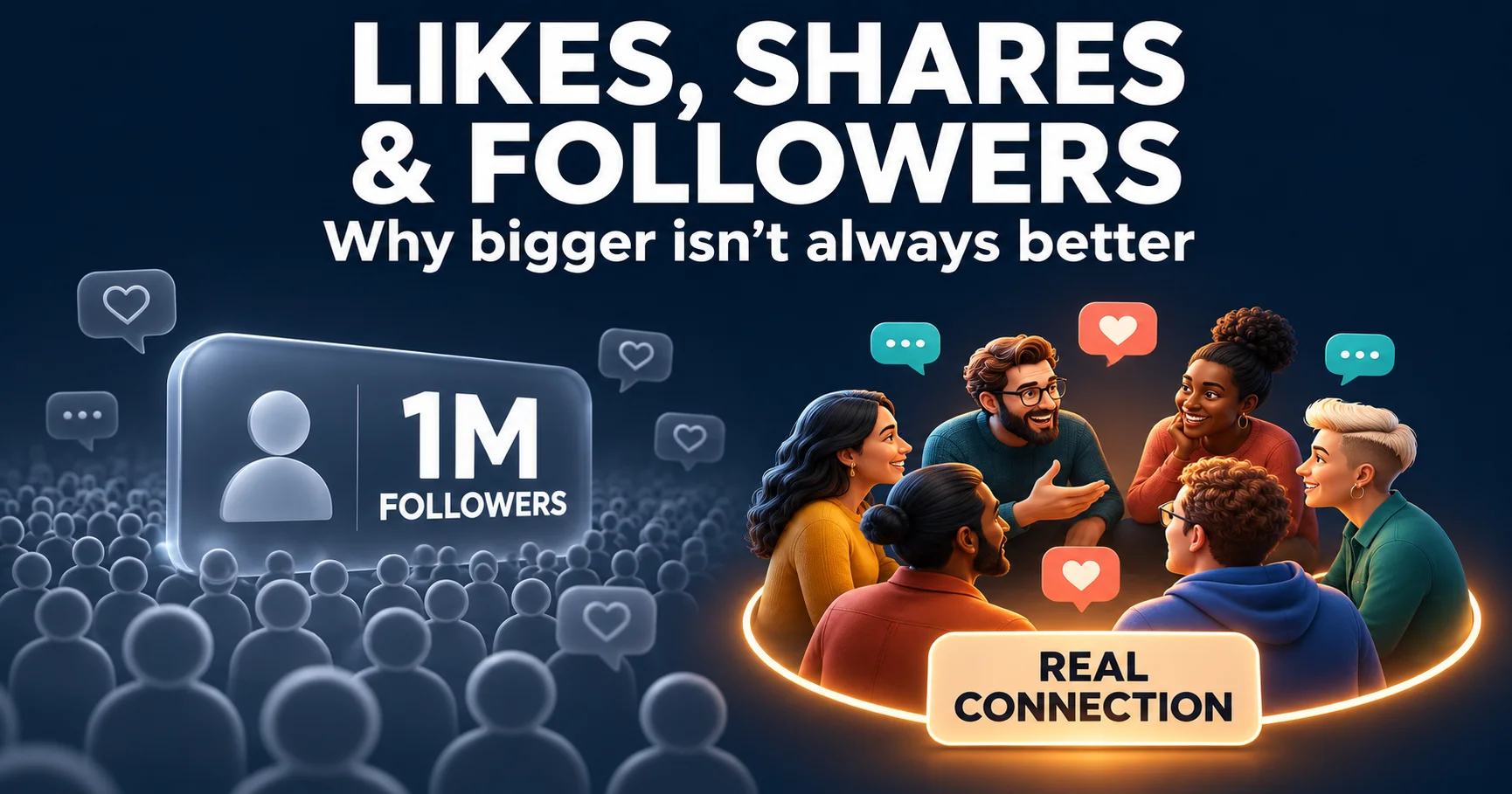
A million followers. Is anybody there?
We have all seen the accounts. A million followers. A handful of reactions. A comments section with the atmosphere of an abandoned telephone box.
The number looks impressive. The relationship with the audience looks considerably less so.
Bought followers and automated accounts are part of this problem. But low engagement alone does not prove that someone bought their audience. Followers become inactive. Interests change. An account changes direction. Some people read everything and never publicly react.
A follower count tells you how many accounts are recorded as following. It does not tell you how many still care, how many see the content, or how many would notice if the creator disappeared tomorrow.
Fifty thousand people who regularly watch, read, respond and return can be far more valuable than a million accounts with very little interest in what you say or do.
That applies whether you want to sell something, build a community or eventually earn money from your work.
Following is no longer a delivery guarantee
A follow is an expression of interest. It is not a standing instruction that every future post must be delivered.
Recommendation feeds also bring people content from accounts they have never followed. Meta describes AI systems that predict relevance across different surfaces. YouTube describes recommendations informed by viewing habits, feedback and satisfaction, alongside subscriptions and likes.
There is no single universal algorithm. Different platforms, formats and feeds work differently, and their systems keep changing. Especially TikTok.
For creators, the practical implication is straightforward. The size of your existing audience CANNOT do all the work for your next post.
You still need to give somebody a reason to stop, stay and return.
A like is a signal. It is not a business plan
A like might mean “I loved this”. It might also mean “I know”, “I agree”, “nice dog”, or “my thumb slipped”.
A share might be a recommendation. It might also be someone sending a post to a friend with the message: “Look at this absolute nonsense.”
Even comments need context. A hundred people arguing beneath a misleading headline might produce activity without creating trust.
This is why I look beyond the public scoreboard. Depending on the account’s purpose, I want to know:
- Are people staying with the content or abandoning it?
- Do they return for the next instalment?
- Are the comments thoughtful and relevant?
- Are people saving useful material or recommending it to others?
- Does attention turn into enquiries, purchases, subscriptions or a stronger community?
These are questions for judging results.
A tutorial that quietly solves somebody’s problem may be doing its job brilliantly without collecting a mountain of likes. A post with thousands of reactions may achieve absolutely nothing beyond those reactions.
The numbers still matter. Numbers without context tell you very little.
Posting more is not the same as contributing more
There is a certain type of account that seems to exist everywhere at once. We've all seen the endless recycled posts, provocative headlines and the same material scattered across group after group.
AI and automation can make that operation remarkably easy to scale. They do not make the output useful, accurate or worth anybody’s time.
I work with AI. I am hardly going to pretend the tool itself is the problem. The problem is using it to manufacture unchecked material and provoke reactions at industrial speed.
Meta has explicitly announced reduced reach and monetisation restrictions for certain spam behaviours, including networks distributing the same spammy content and coordinated fake engagement.
Relevant cross-posting can be perfectly sensible. Flooding unrelated communities with repetitive material is a different proposition.
If your distribution strategy depends on exhausting every group administrator within a fifty-mile radius, it probably needs revisiting.
“Please like and share” is now part of the problem
A reasonable invitation to support your work is understandable. Repeated attempts to extort shares and reactions can turn the content into an engagement exercise.
Facebook has long described demoting engagement bait, with stronger reductions for Pages that repeatedly use it. Its published explanation specifically describes machine learning used to identify these tactics.
So this is not simply a new development where “AI now judges everyone”. Automated ranking has been around for years. Nor is there a universal list of forbidden words or one quality score applied identically everywhere.
Platform exception: YouTube explicitly allows creators to encourage viewers to like, share, comment and subscribe.
There is a big difference between inviting participation and manufacturing it.
My advice is simple:
Give people a reason to like or share your work instead of repeatedly begging them to do so.
Paying for exposure does not buy loyalty
This is where creators need to be very careful.
Advertising a product or service can make commercial sense when the audience, budget and desired outcome are clear. A creator can also have a legitimate campaign objective, such as promoting a release or an event.
But spending money because you hope a bigger view count will eventually turn into fame is a very different calculation.
You can pay to put content in front of people. You cannot purchase their lasting interest.
I would argue that many platforms deliberately suppress your organic reach once they discover you are willing to pay. I would not present this as fact, but this is something I have seen suggested by the statistics.
The stronger objection is that paid distribution can make your headline statistics look healthier without proving people will return voluntarily. YouTube also states that subscribers and watch hours gained through ad campaigns do not count towards its Partner Programme eligibility thresholds.
My advice to a personal creator chasing exposure is to build evidence of audience interest before buying more attention. If you cannot explain what success would look like beyond “more views”, keep your money in your pocket.
If you do test advertising, measure what happens afterwards. Do those people return, engage meaningfully or take the action you intended?
A campaign ending should not mean your entire audience disappears with it.
My top 10 social media do’s and don’ts
1. Do define your audience. Don’t try to interest everybody.
Know who a particular account is for and what people can expect. A focused professional account needs a clearer promise than my personal collection of assorted fascinations.
2. Do earn followers. Don’t buy a decorative audience.
Avoid fake followers, automated reactions and engagement swaps. They inflate the display while making it harder to understand who actually values your work.
3. Do study retention. Don’t stop at the view count.
Look at where viewers leave and whether they return. Compare similar formats and lengths; a short clip and a long tutorial need different expectations.
4. Do deliver on your opening. Don’t use misleading hooks.
A strong headline helps people recognise something worth their attention. If the content fails to deliver, you have given them a reason to distrust the next one.
5. Do invite conversation. Don’t manufacture engagement.
Ask relevant questions and respond to the answers. Repeated demands for shares, reactions, meaningless comment prompts and guilt trips offer very little reason to stick around.
6. Do publish at a sustainable pace. Don’t flood the feed.
Choose a schedule that leaves room for quality and replies. There is no magic posting frequency that turns unwanted material into something people want.
7. Do contribute original value. Don’t become a copying machine.
Offer experience, explanation, humour, creativity or useful curation with proper credit. Use AI thoughtfully, check factual claims and take responsibility for what you publish.
8. Do respect each community. Don’t carpet-bomb groups.
Read the rules, adapt the post and contribute beyond dropping links. Being relevant in one group does not make you relevant in the next hundred.
9. Do give spending a measurable purpose. Don’t buy hope.
Set a budget, a meaningful outcome and a stopping point. Separate paid results from organic results so you can see what your money actually achieved.
10. Do build relationships patiently. Don’t sacrifice trust for a spike.
Listen, respond and improve. Slow growth deserves patience when people are staying and returning; if they are not, change the approach rather than simply waiting longer.
An audience worth having
Organic growth is worth its weight in gold because people are choosing to give you their attention. Building that relationship takes time, and it still takes work to keep it.
Organic does not automatically mean good. Rage bait can spread organically too. What matters is attracting people for reasons you are happy to keep delivering on.
There is nothing wrong with ambition or wanting your work to reach more people. But there is a difference between building an audience and decorating a profile with numbers.
I would rather have a smaller community that notices when I post than a million followers who would need introducing to me.
And if your interests are niche, let them be niche. Somewhere out there are people who find your unique brand of dull just as exciting as you do.
The number beside your name tells you how many accounts followed. What people choose to do next tells you far more.