
Meta Accounts Are Coming to Facebook: What They Are, What They Aren't, and Why You Shouldn't Panic
Meta Accounts are coming to Facebook, and social media is already full of rumours about compulsory digital ID. But what's actually changing? As someone who's used Meta Accounts for years, I explain what they really are, what remains optional, and why there's no need to panic.
Published 20 Oct 2026, 10:00 BST · Last edited 20 Oct 2026, 10:28 BSTShare this page ↗
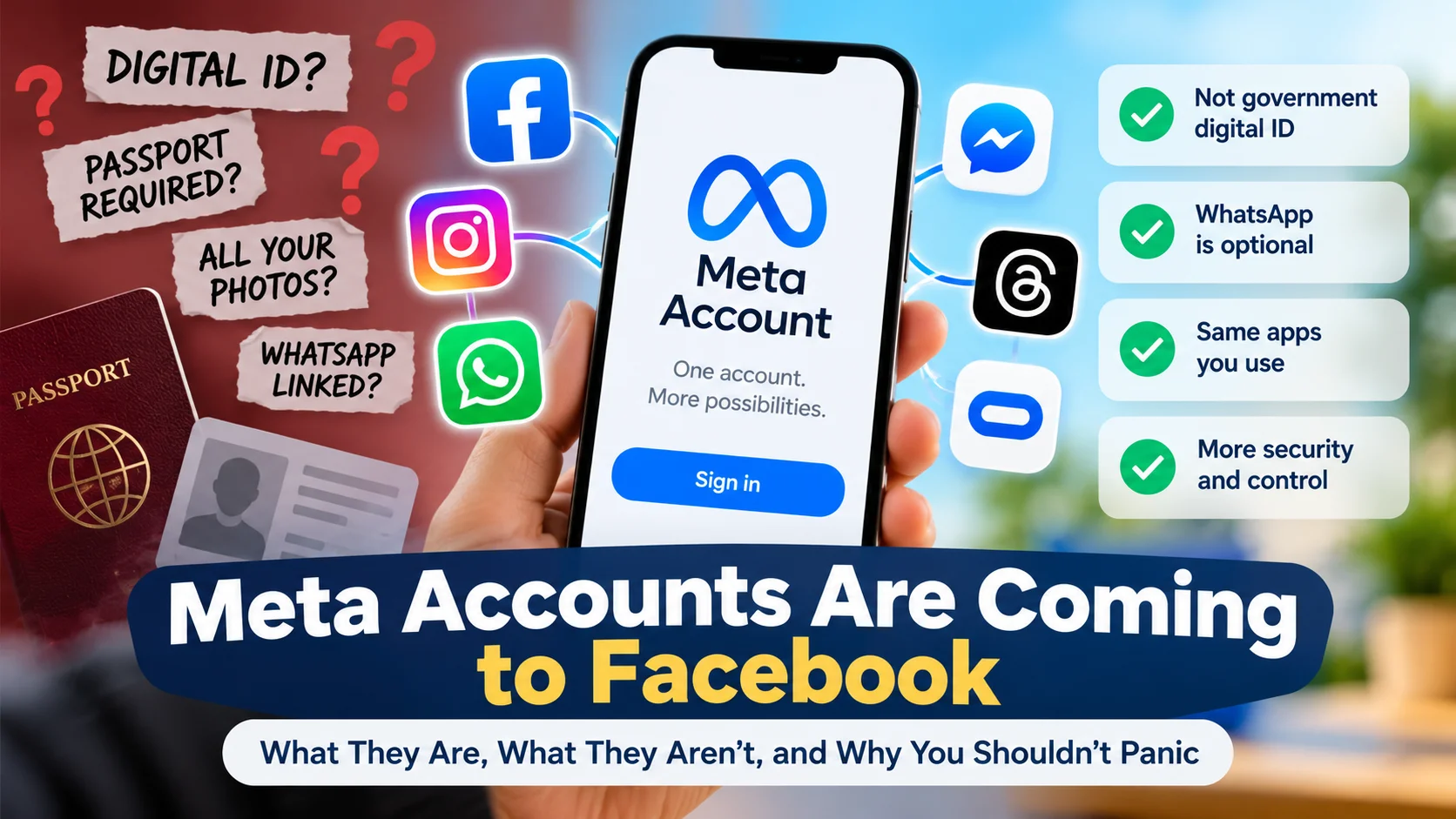
Meta is introducing a unified account system across Facebook, Instagram, Messenger and its other platforms, with the rollout continuing into 2027. But is this really the beginning of compulsory digital ID, as some social media posts suggest? Let's separate the facts from the rumours and explain what it actually means for everyday users.
Another Day, Another Facebook Panic
If you've spent any time scrolling through Facebook recently, you've probably encountered posts warning that Meta Accounts are coming, that they're somehow connected to government digital ID, and that we should all abandon social media before it's too late.
Some people are deleting photographs, others are threatening to boycott Facebook, and a few are contemplating a return to landline telephones.
I've even seen suggestions that this is the beginning of some enormous digital identity system designed to track our every movement.
Now, I'm certainly not someone who believes we should blindly trust large technology companies. Quite the opposite. I work in technology and digital transformation, and I believe people should understand exactly what they're signing up for, what information they're sharing, and how that information might be used.
But there's an important difference between legitimate concerns about privacy and making assumptions about technology we haven't fully understood.
And in this particular case, much of the alarm appears to be based on a misunderstanding of what a Meta Account actually is.
So, let's clear a few things up.
First, What Exactly Is a Meta Account?
A Meta Account is essentially a centralised login and account management system for services owned by Meta Platforms, the company behind Facebook.
Think of it as a single place where you can manage your login credentials, security settings, and connections between different Meta services.
It's similar in principle to how a Google Account works across Gmail, YouTube, Google Drive and other Google services.
Or how a Microsoft Account can be used across Windows, Outlook, OneDrive and Xbox.
Rather than maintaining entirely separate login systems for every product, companies provide a common authentication system that can work across their services.
This is commonly known as Single Sign-On (SSO).
It's far from being a revolutionary concept. In fact, organisations have been using variations of it for decades.
Meta's system can support Facebook, Instagram, Messenger, Threads, Meta AI, Meta Quest virtual reality headsets and Meta's AI glasses.
WhatsApp can also be connected, but importantly, that connection is optional.
The purpose is primarily convenience, account management and security. Instead of repeatedly managing passwords, recovery options and security settings across different applications, users can manage more of these things centrally.
That's the basic idea.
And for those wondering whether this is some completely new invention, it isn't.
Meta Accounts have actually existed for years.
Source: Meta's official announcement, April 2026.
I've Already Been Using a Meta Account for Years
Here's where I can offer a little personal experience.
I'm a Meta Quest user, and I've had a Meta Account for quite some time.
In fact, Meta Accounts were introduced for virtual reality users back in August 2022.
Before that, Meta had been moving towards requiring Facebook accounts to access its VR ecosystem, something that understandably attracted criticism from users who didn't want their gaming hardware tied to their social media identity.
Meta subsequently introduced dedicated Meta Accounts, allowing people to use their VR headsets without needing a Facebook account.
That's worth emphasising.
The original Meta Account system actually gave VR users greater separation from Facebook, not less.
It allowed users to maintain a Meta login for their headset and manage their VR purchases independently of their Facebook profile.
I've been using this system for years, accessing VR applications, managing my headset and purchasing software.
No government-issued digital identity has been involved.
No compulsory connection to WhatsApp.
No requirement to turn my Facebook profile into some sort of universal identity card.
Just an account used to access a company's products.
Source: Meta Accounts and Horizon Profiles for VR, July 2022.
So What's Actually Changing Between 2026 and 2027?
On 23 April 2026, Meta announced that it would expand and improve its existing Meta Account system.
The change builds upon something many Facebook and Instagram users may already be familiar with: Accounts Centre.
Accounts Centre has existed for several years and allows users to manage connected experiences between Meta services.
For example, you may already have used it to connect your Facebook and Instagram accounts, allowing you to share posts between them or manage certain account settings together.
Meta is now bringing this functionality under its broader Meta Account system.
According to the company's announcement, the transition will happen gradually over approximately twelve months, taking the rollout into April 2027.
If you already have accounts within Accounts Centre, those existing connections will be carried over automatically.
Users will be notified as the changes reach their accounts.
Meta also says that the update is not intended to change how people use Facebook, Instagram or their other applications on a day-to-day basis.
Your Facebook profile doesn't suddenly disappear.
Your photographs don't automatically become public.
Your Instagram account doesn't suddenly start publishing everything to Facebook.
And your WhatsApp conversations don't suddenly appear on your Facebook timeline.
The principal changes concern how accounts are accessed, connected and managed.
Important: The migration from Accounts Centre to Meta Account is automatic. Meta has not described that underlying transition as optional for people continuing to use the affected services.
However, that doesn't mean every Meta service must be connected to one account.
Meta explicitly allows users to maintain different Meta Accounts for different applications or devices.
For example, you can have one Meta Account associated with Facebook and another associated with Instagram.
You aren't required to consolidate everything into one account.
Is This Government Digital ID?
This is probably the biggest misunderstanding circulating on Facebook.
No. The Meta Account rollout is not the introduction of a compulsory government digital identity system.
A Meta Account is an account issued and managed by a private technology company to access that company's services.
A government digital identity system is something that's completely different.
Digital identity schemes are generally intended to provide a way of proving information about a person, such as their legal identity, age or eligibility to access particular services.
For example, the UK government has been developing GOV.UK One Login and its wider digital identity infrastructure.
Those initiatives concern access to government services and, potentially, the use of digital credentials to establish identity.
Meta's account system is not part of that government programme.
There is no evidence in Meta's April 2026 announcement that ordinary users will need a government-issued digital ID to continue using Facebook as a consequence of this rollout.
It does not introduce a universal citizen identification number.
It does not require you to register with the government.
And it does not make your Facebook profile a government-issued identity document.
It's important to recognise that both systems involve digital accounts, but that doesn't make them the same thing.
Your Netflix login is a digital account.
Your online banking login is a digital account.
Your supermarket loyalty app probably has a digital account.
That doesn't automatically make any of them part of a government digital identity scheme.
Further reading: UK Government guidance on digital identity.
Will Facebook Require My Passport, Driving Licence or Face Scan?
Not simply because of this Meta Account rollout.
The announcement does not introduce a general requirement for Facebook users to upload passports, driving licences or biometric information when their accounts transition.
However, there's an important point worth making here.
Facebook already has identity verification procedures in certain circumstances.
For example, someone recovering a compromised account might be asked to provide additional evidence of their identity.
Meta also operates separate verification products.
Its subscription-based Meta Verified service has used government identification to authenticate eligible accounts.
In July 2026, Meta also announced a separate feature called Facebook Verified, offering eligible users a free verification badge based on a video selfie, initially in selected markets.
These are different features with different purposes.
Having a Meta Account, subscribing to Meta Verified and obtaining a Facebook Verified badge are not the same.
Nor should we confuse account security with government identity verification.
One is about establishing that the person attempting to access an account is authorised to do so.
The other concerns proving aspects of someone's real-world identity.
Sometimes those processes overlap, but they are not interchangeable.
And Meta's new unified account system does not, by itself, make identity document verification mandatory for every Facebook user.
Further reading: Meta's explanation of Meta Verified.
What About Fingerprints and Facial Recognition?
Another feature attracting attention is the introduction of improved support for something called passkeys.
Passkeys are increasingly replacing conventional passwords.
Rather than typing a password, you can authenticate using your phone's fingerprint reader, facial recognition system or screen-lock PIN.
This might sound concerning if you assume Facebook is collecting your fingerprint or storing an image of your face.
But that isn't how standard passkey authentication works.
In a typical passkey system, your device handles the local authentication and uses cryptographic credentials to prove that you're authorised to access the account.
Meta has explicitly stated that the fingerprint, face scan or PIN used for its Facebook passkeys remains on the user's device and is not shared with Meta.
Passkeys are also resistant to many common phishing techniques.
If someone tricks you into visiting a fake Facebook login page, a properly implemented passkey system makes it significantly harder for that website to steal credentials that could be reused to access your account.
And importantly, using passkeys is optional.
You can continue using supported alternative authentication methods.
Personally, I see passkeys as a useful security improvement, although they're not a substitute for protecting your devices and keeping your recovery information secure.
Source: Meta's explanation of Facebook passkeys.
What About WhatsApp? Will Everything Be Connected?
This is another area where people are understandably asking questions.
WhatsApp is owned by Meta, but that doesn't mean it must be connected to your Facebook or Instagram account.
Meta has explicitly confirmed that adding WhatsApp to your Meta Account is optional and off by default for users who haven't already connected it.
If you have never connected WhatsApp to Accounts Centre, it will remain separate when the new system arrives.
If you've previously chosen to connect WhatsApp, that connection will carry over, but you can remove it.
There are legitimate reasons why somebody might want to connect the services.
For example, you might want to share a WhatsApp Status update directly to Facebook or Instagram without having to upload the same photograph repeatedly.
Or you might prefer certain integrated account features.
But if you don't want those conveniences, you can simply leave WhatsApp separate.
Will Meta Be Able to Read My WhatsApp Messages?
Connecting WhatsApp to a Meta Account does not remove the end-to-end encryption protecting ordinary personal WhatsApp messages and calls.
End-to-end encryption means that the content of a message is encrypted so that the intended recipients can decrypt it.
Meta says that personal WhatsApp messages and calls remain protected whether or not WhatsApp is connected to a Meta Account.
However, it's important not to confuse message encryption with complete anonymity.
WhatsApp still processes certain account, technical and usage information.
Depending on the circumstances, that can include information such as your phone number, device information and aspects of how you use the service.
WhatsApp also shares certain information with other Meta companies for specified purposes, even without optional account linking.
So although Meta cannot simply read the contents of your ordinary end-to-end encrypted personal conversations, that doesn't mean the company possesses no information about your use of WhatsApp.
Those are two very different privacy considerations.
Source: Meta's announcement about optional WhatsApp integration.
Does Connecting Accounts Mean Meta Can Collect More Information About Me?
Now we're getting to a genuinely worthwhile privacy discussion.
And this is where I think people should concentrate their attention rather than worrying about imaginary digital passports.
Meta operates one of the world's largest advertising businesses.
Information about people's interests, interactions and online activities is commercially valuable.
Connecting services can make it easier for Meta to associate information across those services.
In fact, Meta's own Accounts Centre documentation explains that information from connected accounts can be used to provide personalised experiences, including advertising and suggested connections.
For example, if your Facebook and Instagram accounts are connected, certain information from both may contribute to how Meta personalises your experience.
That doesn't necessarily mean every piece of information is shared indiscriminately.
Different services have different privacy rules, and WhatsApp personal message content remains protected by end-to-end encryption.
But the broader principle is more important.
Convenience often involves a trade-off between integration and separation.
The more services you connect, the easier it can become for the provider to recognise and associate your activities across them.
That isn't a new phenomenon introduced by Meta Accounts.
It's been a feature of integrated technology ecosystems for years.
It's also worth understanding that keeping accounts separate doesn't guarantee Meta cannot associate information through other permitted data-processing activities.
Account separation is a useful control, not an absolute privacy barrier.
So rather than assuming everything is completely private or, conversely, that everything is being monitored, users should review the actual settings and policies governing their accounts.
Further reading: Meta's Accounts Centre documentation.
Will Meta Keep My Photographs Forever?
I've also noticed people deleting photographs because they believe the introduction of Meta Accounts somehow gives Facebook new ownership or permanent possession of their images.
Again, these are separate issues.
The account migration does not itself introduce a new rule requiring people to surrender their photographs.
However, uploading content to any online platform involves agreeing to terms governing how that content may be stored, processed and used.
Meta already has policies concerning photographs, posts and other uploaded information.
Deleting a photograph from Facebook is not necessarily the same as instantly removing every copy of that information from every technical system.
For example, Meta explains that deleting an entire Facebook account can involve a deletion process lasting up to 90 days, with certain information potentially retained longer in backups or for legal and safety reasons.
Those retention rules are not newly created by Meta Accounts.
It's also impossible for Facebook to guarantee that somebody else hasn't previously downloaded, copied or screenshotted something you've published.
So my advice remains the same as it has always been.
Don't upload something to a social media platform unless you're comfortable with the possibility that it could exist beyond your immediate control.
That's not specific to Facebook.
It's sensible digital housekeeping.
Further reading: Facebook's account deletion and data retention guidance.
What Are the Actual Benefits?
Despite the understandable scepticism surrounding large technology companies, there are some genuine practical benefits to a unified account system.
For starters, managing passwords and security settings across several services can be unnecessarily complicated.
People frequently reuse passwords because remembering a different password for every application is difficult.
That creates security risks, particularly when stolen credentials from one compromised website are reused elsewhere.
A well-designed central authentication system can help reduce those risks through passkeys, multi-factor authentication and better account monitoring.
It can also simplify the process of recovering access to accounts and managing security alerts.
Having more settings available centrally may make privacy controls easier to find and review.
And for people who regularly use several Meta applications, the convenience of managing compatible services together may be genuinely useful.
However, centralisation also introduces considerations of its own.
If you choose to consolidate multiple accounts under one set of login credentials, protecting those credentials becomes far more important.
A compromised central account could potentially affect access to several connected services.
And if an account is wrongly suspended or becomes inaccessible, recovery may become more consequential.
So centralisation isn't automatically better in every respect.
Like most technology, its value depends upon how it's implemented and how people choose to use it.
What Can You Actually Control?
The important thing to understand is that the move to Meta Accounts doesn't require everyone to make exactly the same choices.
Based on Meta's published guidance, users can:
- Keep WhatsApp separate: You don't have to connect WhatsApp to your Meta Account.
- Use different Meta Accounts: Facebook and Instagram can remain associated with separate Meta Accounts rather than being consolidated into one.
- Choose whether to share passwords: Supported connected services may offer shared-password functionality, but that doesn't mean everyone must enable it.
- Use passkeys where supported: Passkeys offer another way to sign in without making biometric authentication compulsory.
- Review account connections: You can examine connected services and remove supported optional connections, including WhatsApp.
- Manage privacy and security: You can review supported advertising preferences, login alerts and multi-factor authentication settings.
The precise options available may vary according to the services you use, your location and the stage of the rollout.
One useful precaution is to review existing connections before the migration happens.
Within Facebook, open Settings & privacy, then Settings, and look for Accounts Centre or Meta Account.
The name may differ depending on whether your account has already received the update.
From there, review your connected accounts, security settings and advertising preferences.
If you have no reason to connect certain services, there's no obligation to link everything together merely because they're owned by the same company.
And if you receive an unexpected email or message claiming you must urgently verify your new Meta Account, don't blindly follow its links.
Open Facebook directly and check for official notifications within the application.
Account migrations are exactly the sort of events that scammers like to exploit.
Should We Trust Meta?
This is where things become more subjective.
And I don't think anyone should be criticised for questioning the data practices of a large technology company.
Meta has faced substantial scrutiny over privacy, data protection, advertising practices and how information is used across its platforms.
Those concerns are legitimate subjects for discussion.
A unified login system does not erase that history.
Nor does introducing better authentication technology automatically make every aspect of a company's data practices acceptable.
But equally, the existence of those concerns doesn't mean every product announcement is evidence of a sinister new surveillance programme.
We should judge individual changes on what they actually do.
- Does the system improve security?
- Does it provide meaningful choices?
- Are privacy settings clear and accessible?
- Can users understand what information is shared between services?
- Can people maintain separation between their different online activities?
- And importantly, are those choices respected?
Those are the questions worth asking.
There's a world of difference between examining a company's actual privacy practices and assuming that a routine account management update is secretly the beginning of compulsory government identification.
My Thoughts: Be Informed, Not Frightened
I've spent much of my professional life working with technology, cybersecurity, software development and digital transformation.
One thing I've learned is that technology often sounds considerably more intimidating than it actually is when we don't understand what's happening behind the scenes.
Terms like digital identity, biometric authentication, unified accounts and centralised login can sound rather ominous.
But they're descriptions of technologies, not automatic evidence of malicious intent.
A digital identity system designed to prove your legal identity is not the same thing as an authentication system designed to let you log into an application.
And a company allowing users to manage several services through one account doesn't automatically mean those users are surrendering all control over their digital lives.
Having used Meta Accounts through my Quest headset for years, I can say that the underlying concept isn't dramatic or revolutionary.
It's essentially an account management system.
The 2026 announcement expands that existing system across more of Meta's products.
There are many benefits, especially those concerning convenience and security.
There are also perfectly reasonable privacy considerations, especially concerning the information that may be associated across connected services.
Both things can be true.
Personally, I welcome improvements to security and account management, but I also believe users should retain meaningful control over which services they connect and what information they share.
And I certainly don't believe anyone should feel pressured into connecting WhatsApp, Instagram or any other service simply because the option exists.
Technology should work for us, not the other way around.
If someone decides they no longer trust Facebook and wants to leave, that's entirely their choice.
But I'd much rather see people make that decision based on accurate information than because a frightening social media post has convinced them that Mark Zuckerberg is about to demand their passport before allowing them to comment on a photograph of somebody's Sunday roast.
There's quite enough to be concerned about in the digital world without inventing additional reasons to panic.
The Bottom Line
Meta Accounts are not new. They've existed since 2022, initially serving users of Meta's virtual reality products.
The expansion announced in April 2026 is intended to bring Facebook, Instagram and other Meta services under a more consistent account management system.
The transition from Accounts Centre is being rolled out automatically, but users are not required to combine all their Meta services into one account.
WhatsApp integration remains optional.
Passkeys and shared-password functionality offer additional convenience and security choices.
And nothing in the announced rollout establishes a new requirement for ordinary Facebook users to obtain government digital identification.
There are legitimate discussions to be had about privacy, data collection and the growing influence of large technology companies.
Those discussions are important.
But they deserve to be grounded in facts rather than speculation.
Because understanding technology gives us choices. Fearing technology we don't understand simply takes those choices away.
And as for abandoning Facebook for the good old landline telephone?
Well, you're certainly welcome to try.
Just don't expect your grandchildren to answer it!
This article reflects Meta's published announcements and support documentation available as of 20 October 2026. Features, privacy policies and rollout arrangements may change.