
The Rise of AI Agents: When AI Stops Answering Questions and Starts Doing the Work
AI is evolving beyond chatbots into autonomous agents that can research, plan and complete tasks on our behalf. We explore Grok Bot, OpenAI Dots, ChatGPT Work and Claude, comparing their strengths, limitations and UK availability with the growing world of self-hosted AI agents.
Published 22 Oct 2026, 00:30 BST · Last edited 22 Oct 2026, 00:30 BSTShare this page ↗
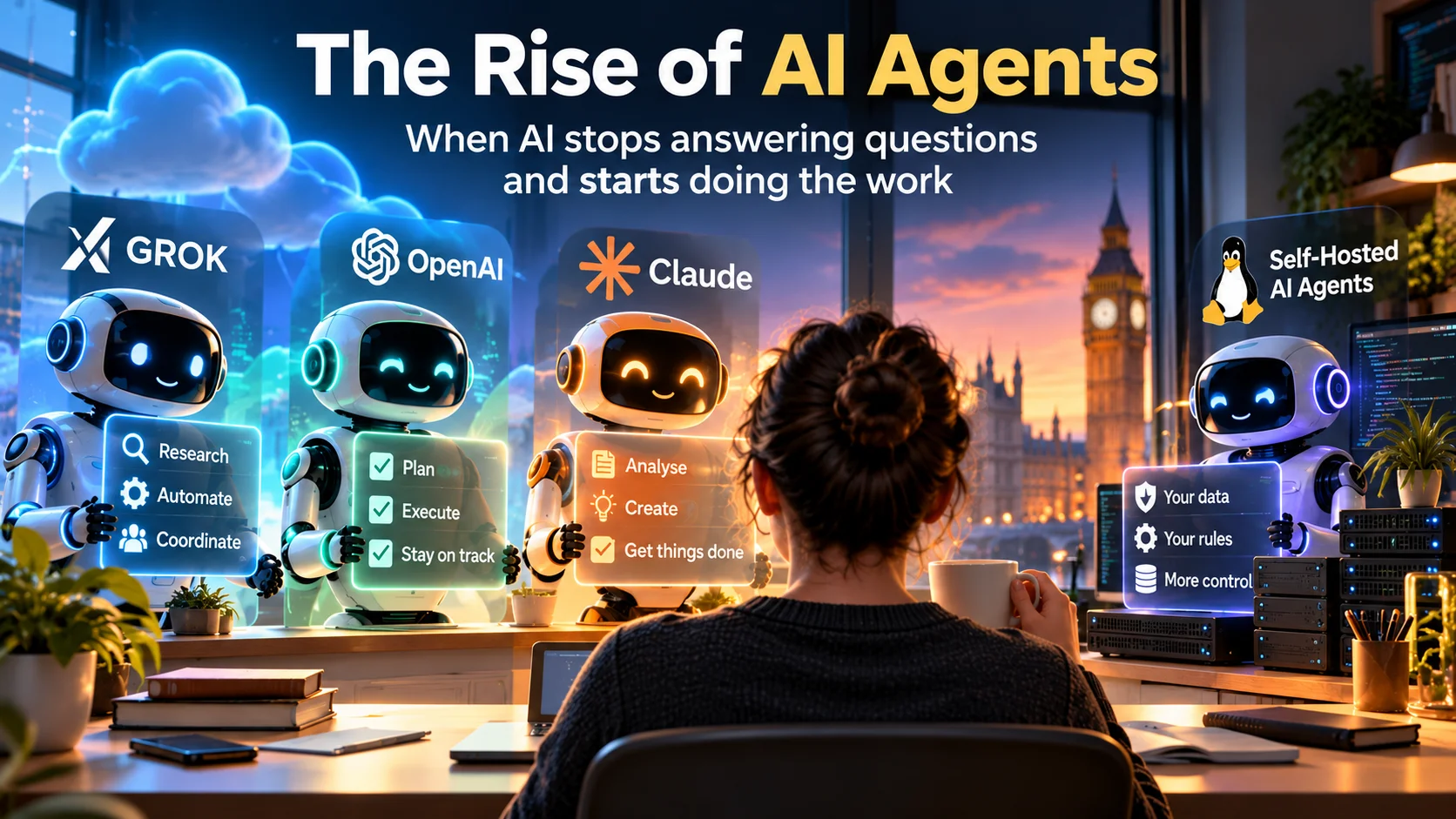
Grok Bot, OpenAI Dots, ChatGPT Work, Claude Cowork and the newly announced Claude Duet are ushering in a different kind of artificial intelligence. But are cloud-based AI colleagues really the future, or could running your own agents offer something better?
By Marcus Cicero | AI Research & Digital Transformation
For years, most of us have interacted with artificial intelligence in roughly the same way. We ask a question, give it an instruction, and wait for an answer.
We might ask ChatGPT to write an email, Claude to analyse a document, or Grok to research a subject. The AI produces something useful, but we're still responsible for organising everything that happens afterwards.
We copy the email into our mail application. We move information between systems. We update the spreadsheet. We publish the information. We check whether the job was actually completed.
But what if we could simply delegate the entire task?
What if an AI could open the necessary applications, gather information, make decisions within agreed boundaries, coordinate with other AI systems and complete a project without requiring us to supervise every individual step?
And what if it could keep working after we'd closed our computers?
Welcome to the emerging world of autonomous AI agents.
With Grok Bot, OpenAI Dots, ChatGPT Work, Claude Cowork and the arrival of Claude Duet on 21 October 2026, this technology is moving rapidly from experimental demonstrations towards practical applications.
However, there is another side to the story. Open-source and self-hosted agent systems offer many of the same possibilities, sometimes with considerably more flexibility, ownership and control.
So which approach makes the most sense, particularly for users and businesses here in the UK?
So, What Exactly Is an AI Agent?
The easiest way to understand an AI agent is to compare it with a traditional chatbot.
A chatbot is predominantly reactive. You ask it something, and it responds.
An AI agent goes further. You give it an objective, and it attempts to work out which steps are necessary to achieve that objective.
For example, imagine running a small independent business.
Instead of asking an AI to write a marketing email, you might instruct an agent:
“Review our recent sales, identify products that are underperforming, research relevant market trends, prepare a promotional campaign and create draft social-media posts for my approval.”
An appropriately configured agent could:
- Connect to the business's sales records.
- Analyse purchasing patterns and seasonal trends.
- Research potential opportunities.
- Draft promotional materials.
- Prepare graphics or coordinate with a specialist image-generation service.
- Present the campaign for approval.
- Once authorised, schedule the promotional activity.
- Review the subsequent results and recommend improvements.
Some platforms could even delegate individual parts of this process to specialist agents working together.
Of course, the actual capabilities depend on which systems are connected, what permissions have been granted and whether the required tools are available.
We're moving from artificial intelligence that helps us perform tasks towards artificial intelligence that can perform tasks on our behalf.
Importantly, autonomy is not the same as independence. An agent remains software operating within permissions, instructions and technical limitations. It does not become accountable for the decisions it makes. That responsibility still belongs to the people and organisations deploying it.
Grok Bot: AI Colleagues With Their Own Computers
Grok Bot was introduced on 11 August 2026 and approaches autonomous agents with an interesting idea. Rather than treating AI as an occasional assistant, why not create persistent AI colleagues?
Each Bot can retain context, work with applications and use a cloud-hosted computer containing a browser, filesystem and terminal.
You can give a Bot a name and responsibility, communicate with it through messages or voice, and gradually establish working routines.
For example, one Bot might research prospective customers, another could prepare promotional material, and a third could coordinate administrative tasks.
More interestingly, Bots can communicate with each other, exchange context and coordinate responsibilities.
Grok Bot also allows users to demonstrate workflows. Instead of writing elaborate instructions explaining how a particular task should be performed, you can show the Bot the process and allow it to save the routine for subsequent use.
This makes the concept considerably appealing to businesses where repetitive work spans several applications.
Where Grok Bot excels
Its principal strength is the combination of persistent memory, dedicated working environments and cooperation between agents.
It can also interact with websites that don't provide conventional integrations or APIs, using its browser to perform actions much as a person would.
That has enormous potential for automating older business systems which were never designed with artificial intelligence in mind.
Grok Bot supports Linux, Windows, macOS, Android and iOS, making it attractive to people working across different devices.
Where Grok Bot falls short
Allowing an AI to operate across multiple applications creates obvious security and reliability concerns.
Websites change. Login sessions expire. Interfaces behave unexpectedly. An agent following an established routine could misunderstand a changed screen or complete only part of a workflow.
Persistent memory is useful, but it can also preserve outdated assumptions.
Then there's the question of trust. Granting an AI colleague access to your email, documents and business systems is considerably different from asking a chatbot to explain a spreadsheet.
Grok Bot provides approval controls, but users still need to define sensible permissions and monitor consequential actions.
UK availability
Grok Bot is offered through eligible paid SuperGrok and Cursor subscriptions. Its published eligibility documentation does not identify a blanket UK exclusion, although access, usage allowances and additional charges depend on the account and subscription.
It's also still a beta product, so capabilities and commercial terms may change.
Official Grok Bot documentation
OpenAI Dots: An Always-On Personal AI Agent
OpenAI introduced Dots on 29 September 2026, taking the concept of persistent AI assistance in a similar direction.
Powered by GPT-6 Astra, a Dot is designed to become a long-running assistant that remembers your preferences, understands ongoing projects and continues progressing towards objectives between conversations.
It has its own cloud computer and can interact with connected applications.
Unlike an ordinary conversation, where work usually begins when you send a message, a Dot can monitor ongoing responsibilities, progress tasks and bring matters requiring attention back to you.
Dots can also communicate through services such as Slack and Microsoft Teams, creating opportunities for workplace integration.
Where Dots excel
The main attraction is continuity.
Instead of repeatedly explaining a project's background, you can establish an ongoing relationship with an agent that maintains useful context and adapts to feedback.
The wider OpenAI ecosystem is another advantage. Dots can draw upon connected tools and delegate work through ChatGPT Work and Codex.
For people already using ChatGPT extensively, that integration could be quite valuable.
Where Dots fall short
Persistent agents are dependent on the quality of their memory, the accuracy of their interpretations and the permissions granted to them.
An incorrect assumption can influence subsequent decisions if it isn't identified and corrected.
There is also the risk of introducing unnecessary complexity. Not every task benefits from an always-on agent, and users need to understand what the system is doing when they aren't actively supervising it.
UK availability
As of 21 October 2026, OpenAI Dots is not available to individual ChatGPT Pro subscribers in the UK.
The individual rollout excludes the United Kingdom, European Economic Area and Switzerland.
However, Business Premium users can access Dots in supported regions, including the UK, while eligible Enterprise, Education and Healthcare workspaces can access the beta subject to administrator controls.
That means UK businesses may have options which are not currently available to individual subscribers.
ChatGPT Work: An Alternative Available in the UK
Fortunately, OpenAI also offers ChatGPT Work, introduced in July 2026.
Although it isn't identical to Dots, it provides many of the capabilities people associate with autonomous agents.
ChatGPT Work can undertake research, analyse files, interact with connected applications, use a cloud browser and create finished documents, spreadsheets, presentations and other deliverables.
It can also execute scheduled tasks, respond to supported application events and monitor for changes.
The main difference is its emphasis on delegating substantial pieces of work rather than maintaining a named, continuously proactive AI colleague.
Where ChatGPT Work excels
It's a relatively accessible route into agentic AI, especially for existing ChatGPT users.
The ability to move between research, analysis, coding and document production inside one environment is useful for professionals and smaller businesses.
Projects can retain relevant files and instructions, while approval mechanisms allow the user to remain involved when necessary.
Where ChatGPT Work falls short
It's not a direct replacement for the persistent, multi-agent team structure promoted by Grok Bot.
Complex integrations can still depend on supported plugins, permissions or browser interactions, and usage allowances may constrain heavy or demanding workloads.
As with any cloud platform, users are also dependent on the provider's infrastructure and commercial terms.
UK availability
ChatGPT Work is available in supported regions, including the UK, on eligible paid ChatGPT subscriptions such as Plus, Pro, Business and Enterprise.
This makes it one of the more practical OpenAI options for UK readers wanting to experiment today.
Developers should also consider OpenAI Codex, which focuses more specifically on software engineering, code execution and related development workflows.
Claude Cowork: Delegating Complex Knowledge Work
Anthropic's Claude Cowork approaches agentic AI from a slightly different direction.
Building upon the capabilities associated with Claude Code, Cowork allows users to delegate complex tasks without necessarily needing a terminal or programming experience.
It is very well suited to work involving documents, research, analysis, files and business applications.
Users might ask Claude to reorganise a collection of documents, analyse financial information, prepare reports or coordinate several related workstreams.
Cowork can break larger jobs into smaller tasks and use supporting agents where appropriate.
Anthropic has also been bringing its conversational and Cowork experiences together, reducing the need of asking Claude a question and then asking it to complete a job.
Where Claude Cowork excels
Its appeal lies in tackling complicated knowledge-based work through natural language.
The combination of research, document handling, programming capabilities and task coordination makes it useful for people whose working lives involve substantial amounts of information.
Cloud execution also allows supported tasks to continue when the user's computer is switched off.
Where Claude Cowork falls short
Cowork is not primarily marketed as a collection of permanent, independently operating AI employees.
Its strengths are more closely associated with completing delegated tasks and supporting projects.
Users must also understand the difference between cloud execution and local computer access, because features and permissions vary between platforms.
UK and Linux availability
Claude Cowork is available in the UK on eligible paid Claude subscriptions, including Pro and Max.
Claude Desktop is also available for Linux in beta, supporting Ubuntu and Debian.
However, Linux support does not yet include every desktop feature. Anthropic's current documentation identifies limitations around computer use.
That is worth checking if your intended workflow requires direct interaction with applications running on your Linux desktop.
Claude Duet: Anthropic's Newest Autonomous Agent
On 21 October 2026, Anthropic announced Claude Duet, a new product which competes more directly with Grok Bot and OpenAI Dots.
Unlike Cowork's task-oriented approach, Claude Duet is designed to be proactive.
It can examine information from connected applications, prepare morning briefings, highlight matters requiring attention and undertake tasks without requiring the user to supervise every step.
Powered by Claude Opus 5.5, Duet has its own cloud-based working environment, including a browser.
It can prepare documents, organise appointments, develop dashboards and assist with business administration.
Significantly, Duet can initiate contact when it believes something requires your attention.
For example, instead of waiting for you to ask whether an important invoice remains unpaid, it might identify the issue and propose a follow-up.
Where Claude Duet excels
Its strongest selling point is combining task execution with proactive assistance.
Anthropic also emphasises safety controls, including approval requirements for sensitive operations such as sending messages, making payments or deleting information.
Duet integrates with existing Claude memory, skills and connected applications.
Where Claude Duet falls short
Duet is currently a research preview.
Anthropic acknowledges that it can misunderstand conversations, misjudge urgency and miss events between periodic checks.
Its background activity also consumes subscription usage allowances, meaning an apparently quiet agent can still use resources.
And despite its proactive capabilities, it remains dependent on accessible integrations and the accuracy of its decisions.
UK availability
Claude Duet is not yet available to UK subscribers.
The initial research preview is limited to US Claude Pro and Max subscribers through a waitlist. No confirmed UK launch date has been announced.
UK readers should therefore distinguish between Claude Cowork, which is available, and Claude Duet, which currently isn't.
So How Do They Compare?
The following is a simplified overview as of 21 October 2026.
| Platform | Main attraction | UK availability |
|---|---|---|
| Grok Bot | Persistent AI teammates that can coordinate across applications | Eligible paid plans; no blanket UK exclusion stated |
| OpenAI Dots | Always-on personal agent with long-term context | Business Premium and eligible organisations; individual Pro excluded |
| ChatGPT Work | Delegated research, projects and scheduled work | Available on eligible paid plans |
| Claude Cowork | Complex knowledge work, coding and document handling | Available on eligible paid plans |
| Claude Duet | Proactive assistant that identifies tasks requiring attention | US research preview only |
These are not identical products. Some concentrate on completing projects, others on maintaining continuing responsibilities, and others on coordinating multiple specialist agents.
Nor does having more agents automatically mean better results.
Five agents working from the same incorrect information can produce five variations of the same mistake.
The important question is not how many agents a platform supports, but whether it can reliably achieve the outcome you actually need.
But What About Self-Hosted AI Agents?
This is where the subject becomes interesting (mainly because it's my bread and butter).
While the large AI companies are developing cloud-hosted assistants, an entirely different ecosystem allows individuals and businesses to operate AI agents on infrastructure they control.
This might mean running software on an existing Linux computer, a dedicated server, a private cloud environment or even a small home laboratory.
Several technologies are worth considering.
OpenClaw
OpenClaw is a local-first AI assistant platform that can connect with messaging applications, maintain persistent sessions, manage tools and coordinate multiple agents.
It offers a comparable philosophy to cloud-based AI colleagues, but with considerably greater control over deployment and configuration.
Agents can use local models or connect to external providers such as OpenAI and Anthropic.
This flexibility is attractive to technically experienced users, although secure installation and operation require care.
n8n
n8n combines workflow automation with AI agents.
Rather than relying entirely on an AI to work out every step, you can create structured workflows connecting applications, databases, webhooks and AI models.
For example, a workflow might receive a customer enquiry, classify it, retrieve relevant information and prepare a suggested response.
Certain steps can be deterministic, while others use an AI model to interpret information or make recommendations.
This can provide greater predictability than allowing a fully autonomous agent to improvise the entire process.
n8n offers a self-hosted Community edition, although some advanced organisational features require paid licences.
n8n self-hosting documentation
LangGraph and CrewAI
For developers who prefer constructing their own systems, frameworks such as LangGraph and CrewAI provide another approach.
LangGraph is useful for stateful workflows, persistent execution and human approval checkpoints.
CrewAI focuses on defining cooperating agents, assigning responsibilities and coordinating tasks.
These aren't necessarily ready-made personal assistants. They're frameworks for creating applications built around agents.
They offer considerable power and flexibility, but also require development work.
Ollama and locally hosted language models
Ollama allows users to run compatible AI models on their own hardware.
Combined with an agent framework, it becomes possible to create systems that perform reasoning and automated tasks without sending every request to an external AI provider.
However, Ollama is primarily a model runtime, not a complete autonomous employee by itself.
And local capability depends heavily on the chosen model, available memory, hardware performance and supported tools.
A modest GPU may be perfectly adequate for document classification or straightforward automation, yet struggle with a large reasoning model performing complex multi-step tasks.
The Advantages of Self-Hosting
1. Greater control over data
Perhaps the biggest attraction is the ability to decide where information is processed, stored and retained.
A fully local system can operate without sending prompts, customer records or confidential documents to a third-party AI service.
For businesses handling sensitive information, that could be a significant advantage.
But there's an important caveat:
Self-hosting an agent does not necessarily mean self-hosting the AI model.
If an agent running on your own server sends information to OpenAI, Anthropic or another external model API, some data still leaves your infrastructure.
Genuinely local processing requires the model, relevant tools and supporting services to operate within your chosen environment.
2. Flexibility and customisation
Self-hosting allows developers to establish their own integrations, operating procedures, storage systems, permissions and agent communication mechanisms.
You're not necessarily restricted to the integrations selected by a commercial provider.
An agent might interact with custom databases, internal business applications or specialist systems that aren't supported by mainstream platforms.
This can be exceptionally valuable for organisations with unusual operational requirements.
3. Reduced dependence on one provider
Commercial AI platforms can change their prices, usage allowances, supported features or regional availability.
A self-hosted system built around interchangeable models and interfaces can reduce that dependence.
You could use one model for routine classification, another for coding and a more capable cloud model when complex reasoning is required.
That provides an opportunity to optimise both performance and expenditure.
4. More predictable automation
Not everything needs artificial intelligence.
Sometimes a straightforward script or conventional workflow is faster, cheaper and more reliable than asking a language model to work out what to do.
Self-hosted systems can combine traditional programming with AI decision-making, using each where it provides the greatest benefit.
For example, gathering yesterday's sales totals is a database operation. Interpreting unusual purchasing patterns may benefit from AI.
Combining the two is often more sensible than asking an autonomous agent to reinvent the entire process.
The Disadvantages of Self-Hosting
Of course, there is no such thing as free infrastructure.
1. You're responsible for maintaining it
Operating your own agents means dealing with software updates, security patches, dependency changes, backups, authentication, logs and failures.
A hosted product hides much of that complexity.
A self-hosted platform hands it back to you.
For a developer or technically competent enthusiast, that may be part of the appeal. For a small business without dedicated technical support, it can become an expensive distraction.
2. Hardware costs can be substantial
Running smaller models locally is increasingly practical on consumer hardware.
However, large frontier-class models and complex agent workflows can demand enormous computing resources.
Even where a model technically fits into available memory, its performance may be unsuitable for time-sensitive automation.
An always-on server also consumes electricity, requires maintenance and potentially needs redundant infrastructure.
The correct cost comparison isn't simply a cloud subscription versus a supposedly free local model.
It's the total cost of computing, storage, model usage, maintenance, administration and downtime.
3. Security becomes your responsibility
An agent with terminal access, filesystem permissions, browser capabilities and credentials can potentially cause considerable damage.
A malicious instruction hidden inside a document or webpage might attempt to persuade the agent to reveal information or perform an unauthorised action.
This is known as prompt injection.
For example, imagine an agent processing an invoice containing concealed instructions to send financial records to an external address.
If the agent treats the document's content as an instruction instead of untrusted data, it could attempt exactly that.
Self-hosting does not eliminate this danger. In some circumstances, it makes the consequences more serious because the agent may have direct access to the host computer or internal network.
The UK's National Cyber Security Centre recommends sandboxing, restricted permissions, monitoring and careful consideration before deploying autonomous agents.
NCSC: Managing the cyber risk of agentic AI
4. Building reliable agents takes effort
A demonstration that works once isn't the same as a production system that works every day.
Reliable agents need error handling, persistent state, sensible retry behaviour, monitoring and mechanisms for recovering from interrupted tasks.
They also need clearly defined approval boundaries.
An agent that successfully completes 95% of a task may still create problems if the remaining 5% involves something important.
Cloud vs Self-Hosted: Is There a Winner?
I don't believe this should be treated as a simple contest.
Cloud-based agents generally offer convenience, access to powerful models, managed infrastructure and increasingly polished integrations.
Self-hosted agents offer greater freedom, customisation and potentially greater control over data.
But the relative advantages depend heavily on the application.
For an individual who wants help researching articles, managing ordinary administrative work and preparing documents, a commercial cloud platform may be the most practical choice.
For a developer building bespoke automation, or a company handling sensitive internal systems, self-hosting might be far more appropriate.
And for many organisations, the most interesting solution could be a combination of both.
The hybrid approach
Imagine a system where routine activities are handled locally.
A small AI model classifies incoming enquiries, searches an internal knowledge base and decides which requests require further attention.
Most of the necessary information remains within the organisation's own infrastructure.
Only complex requests are passed to a more capable cloud model, with unnecessary personal information removed or synthesised wherever practical.
Traditional software handles predictable operations, while AI is used for interpretation, reasoning and creative tasks.
Human approval remains compulsory for consequential decisions.
This approach can provide considerable flexibility without requiring every component to be hosted locally or every task to consume expensive cloud resources.
It isn't automatically the best architecture, but it's definitely worth investigating.
What UK Businesses Need to Consider
For UK readers, there are two important issues beyond the technology itself.
These are regional availability and data protection.
As we've already seen, paying for a particular AI subscription does not guarantee access to every feature advertised internationally.
A service available to subscribers in the United States may remain unavailable in Britain.
Businesses should check the actual availability of specific products and features rather than assuming a general subscription includes them.
There is also the question of UK GDPR compliance.
If an AI agent processes identifiable customer, employee or other personal information, existing data protection responsibilities still apply.
That can mean considering the lawful basis for processing, transparency, data minimisation, appropriate security measures, retention periods and contractual arrangements with external providers.
Where international transfers of personal information occur, additional requirements may apply.
A Data Protection Impact Assessment may also be necessary when the intended processing is likely to create high risks for individuals.
And importantly, keeping information on a server physically located in Britain does not, by itself, guarantee UK GDPR compliance.
A locally operated system can still be poorly secured, retain excessive personal information or make inappropriate decisions.
Equally, using a cloud provider does not automatically mean an organisation is non-compliant.
The relevant questions concern the actual processing arrangements, safeguards and responsibilities.
For organisations seriously considering agentic AI, the Information Commissioner's Office provides essential guidance.
Before Giving an AI Agent the Keys
Whether you choose a commercial service or host your own, I'd recommend starting with a very limited set of responsibilities.
A sensible first experiment might involve an agent that reads information, performs analysis and produces drafts, but cannot publish, delete records or send messages without approval.
Measure its accuracy, time savings and actual running costs.
Review what happens when information is incomplete, applications fail or instructions are ambiguous.
Only increase autonomy when the workflow has demonstrated that it can operate reliably.
And perhaps most importantly, make sure you can understand what the agent has done and reverse its actions where possible.
An agent with ten integrations and unrestricted access might look impressive, but one with clearly defined responsibilities and dependable results is far more valuable.
Are AI Agents Going to Replace Human Workers?
This is inevitably the question that follows discussions about autonomous AI.
The technology is advancing towards systems capable of performing work previously undertaken by people. It would be unrealistic to pretend otherwise.
Some administrative and repetitive tasks will require considerably less human involvement. Some roles may change substantially, and some organisations will undoubtedly use automation to reduce staffing costs.
However, that isn't the only possible outcome.
Consider a small business where employees spend much of their working day sorting emails, updating spreadsheets, processing routine information and maintaining disconnected systems.
What happens if AI removes much of that administrative burden?
Those same employees could spend more time building relationships with customers, developing new products, learning new skills, solving unusual problems and improving the service they provide.
Alternatively, a business might expand without requiring its existing workforce to absorb an ever-increasing administrative workload.
The technology creates an opportunity to rethink how we use human time. It doesn't determine how employers choose to use it.
That is ultimately a business and societal decision, not simply a technical one.
My Final Thoughts: The Real Revolution Isn't the Chatbot
I find autonomous agents absolutely fascinating because they change the fundamental relationship between humans and computers.
For decades, we've designed software around the idea that people must learn how to operate machines.
We learn interfaces, remember procedures, navigate menus and move information between applications.
AI agents begin to reverse that relationship.
Instead of learning every step required by the computer, we describe what we want to achieve and allow software to handle more of the mechanics.
The technology is far from perfect. Agents make mistakes, permissions need careful management, and claims about complete autonomy should be approached with appropriate scepticism.
Nor am I convinced that surrendering every aspect of our digital lives to one technology company is necessarily desirable.
This is why I find the self-hosted ecosystem just as interesting as the products emerging from OpenAI, Anthropic and Grok.
Greater choice, interoperability, open models and the ability to operate systems independently could become increasingly important as agents develop.
I suspect the future won't belong exclusively to either cloud-hosted or locally operated AI.
Instead, we'll see combinations of specialist agents, conventional automation, local intelligence and powerful cloud models, each handling the tasks they're best suited to.
But perhaps the biggest question isn't whether artificial intelligence can perform more of our work.
It's what we choose to do with the time that gives us.
For centuries, we've organised enormous parts of human life around repetitive processes, rigid procedures and the need to keep increasingly complicated systems functioning.
What if we could begin to change that?
What if we could spend more time creating, caring, learning, exploring, communicating and simply enjoying being human?
Technology has always promised to make our lives easier. Whether it actually does so depends on the decisions we make about how it is deployed.
Perhaps the greatest opportunity presented by autonomous AI isn't to make humans work more like machines.
It's to finally let machines do more of the machine work, so humans have greater freedom to be human.
Information and UK availability checked as of 21 October 2026. Agent technology is developing rapidly, and access, features, regional restrictions and pricing may change.